
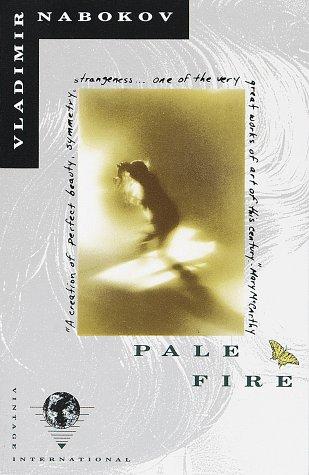
Pale Fire
Vladimir Nabokov · 1899–1977 · Russia / USA
Why it matters
A 999-line poem and the deranged commentary that hijacks it: a novel assembled by the reader from footnotes. Postmodernism's favorite magic trick, and possibly Nabokov's most perfect construction.
At a glance
Nonlinear footnote structure forces the reader to assemble plot and unreliable narrator's delusions themselves.
Deep dive
A dead poet's 999 lines get buried under his neighbor's four-hundred-page commentary, and the commentary is not remotely about the poem it claims to explain.
Written for readers who have finished the book. No plot recap, and nothing here is safe to read first.
Themes & symbolism
John Shade's poem 'Pale Fire' is a plain, formally exact elegy: four cantos in heroic couplets about his own life, his wife Sybil, and his daughter Hazel, threaded through with an amateur philosopher's attempt to find some pattern behind a chance coincidence involving a magazine misprint. It is modest, domestic, and grief-struck, and Charles Kinbote's facing commentary almost never engages with a single one of those subjects, redirecting nearly every line toward the exiled kingdom of Zembla and its fugitive king, whom Kinbote is convinced the poem is secretly about.
Nabokov built the book as a trap for readers who mistake confidence for reliability: Kinbote's prose is erudite, funny, and utterly persuasive on its own terms, so the reader has to do the work Kinbote refuses, holding his footnotes against Shade's actual verse to notice how completely one man's fantasy has annexed another man's mourning. Gradus, the assassin Kinbote insists is stalking across Europe toward New Wye to kill the exiled king, turns out in Shade's own account of the circumstances of his death to be someone else entirely, a small, damning gap between what the commentary asserts and what the poem and the facts around it actually support.
Kinbote or Botkin
Nabokov scatters enough evidence to support a second, colder reading beneath Kinbote's own: that he is not an exiled Zemblan king at all but V. Botkin, a delusional Russian émigré academic on the New Wye faculty, and that Zembla, its palace intrigues, and its regicide are an invented refuge built out of homesickness and a mind coming apart. The index entry for 'Botkin' and the anagram sitting inside Kinbote's own invented vocabulary are the kind of clue Nabokov specialized in planting for a second reading rather than a first, and the novel never settles the question, because settling it would trade the vertigo of two competing realities for the comfort of one.
Hazel Shade's Buried Poem
Shade's third canto is the emotional center of 'Pale Fire': his account of Hazel, an unhappy, unpopular girl, and his and Sybil's raw, specific grief for her, down to the games she played alone and the science-fair project she never finished. Kinbote's commentary treats this canto as an inconvenience, skimming past Hazel to get back to Zembla, and that neglect is Nabokov's cruelest joke on his own narrator: the reader who does the work Kinbote won't finds a more moving book hiding directly underneath the one Kinbote is so eager to tell.
Where to go next
 Vladimir Nabokov · 1938Invitation to a BeheadingLvl 7Slow burn
 Vladimir Nabokov · 1951Speak, MemoryLvl 6Slow burn
 Vladimir Nabokov · 1955LolitaLvl 8Medium pace
 Vladimir Nabokov · 1957PninLvl 4Medium pace
 Vladimir Nabokov · 1969Ada, or Ardor: A Family ChronicleLvl 9Slow burn
 Nikolai Gogol · 1842Dead SoulsLvl 5Medium pace