
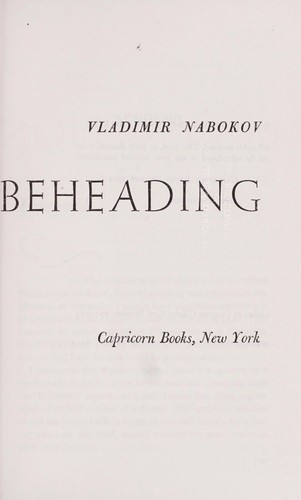
Invitation to a Beheading
Vladimir Nabokov · 1899–1977 · Russia / USA
Originally Priglashenie na kazn (Russian)
Why it matters
Cincinnatus C. is condemned to death for the crime of being opaque to everyone around him, awaiting execution in a prison as absurd as his sentence. Nabokov's most overtly Kafkaesque novel, written in Russian before he had ever read Kafka, or so he always insisted.
At a glance
Deliberately artificial, dreamlike logic dissolves setting and character into pure allegory.
Deep dive
A man is condemned to death for the crime of being opaque in a world where everyone else is transparent, and Nabokov stages his execution as a piece of civic theater that the whole town has been looking forward to.
Written for readers who have finished the book. No plot recap, and nothing here is safe to read first.
Themes & symbolism
Cincinnatus C. is sentenced to death for gnostical turpitude, a charge Nabokov never defines except by implication: in a society of people who are essentially see-through to one another, sharing thoughts and reactions with no friction, Cincinnatus is opaque, possessed of an inner life the state cannot read and therefore cannot tolerate. The novel refuses the flat bureaucratic realism of Kafka's trials in favor of something deliberately theatrical and unstable, walls that wobble, spiders serving as jailers, a fortress whose geography changes between chapters, because the world persecuting Cincinnatus is, Nabokov keeps signaling, cheaply made, a stage set rather than a genuine reality.
Monsieur Pierre, who first appears as a fellow prisoner sharing Cincinnatus's cell, cultivates an increasingly intimate, chummy friendship before being revealed as the executioner assigned to behead him, and that reveal is the novel's clearest thesis about how this kind of power actually operates: not through open menace but through a performance of intimacy designed to make the condemned man complicit in his own end, to get him to like the person who will kill him. Cincinnatus's wife Marthe, flighty and serially unfaithful even during visiting hours, and his own parody of a family who arrive for a farewell dinner arguing about furniture, complete the picture of a man surrounded entirely by people incapable of recognizing what is actually happening to him, or unwilling to.
Nabokov wrote the novel in Russian in 1934, years before he would meet the specific vocabulary of twentieth-century totalitarianism that later readers reflexively apply to it, and insisted for the rest of his life that it was not a satire of any government in particular, not Stalin's, not Hitler's, but an assault on what he called average reality itself, the false consensus that a shared, legible surface is more true than any single person's interior life. That refusal to name a target is what keeps the novel disturbing rather than merely topical: the crime of being unreadable to your neighbors does not require a specific regime to prosecute it.
An Executioner Who Wants to Be Liked
Nabokov spends far more of the novel on Pierre's cultivated charm, his card games and confidences with Cincinnatus, than on any actual threat of violence, and the imbalance is the point: the novel's real horror is not the blade but the amount of social effort a totalitarian system will invest in making its victim complicit, friendly, even grateful, before it kills him. Pierre never drops the performance, cheerfully directing the condemned man toward his own scaffold as though escorting a guest to a seat of honor.
The last seal: what actually happens, and why it lands the way it does.
The ending, explained
On the scaffold, with Pierre's axe raised and the assembled crowd waiting for the spectacle it has been promised, Cincinnatus simply refuses to keep performing his assigned role: he gets up mid-execution and starts walking away, and as he does the entire fabricated world around him, the spectators, the buildings, even the dust in the air, collapses like a theater set being struck at the end of a run. Nabokov leaves what happens to Cincinnatus physically deliberately unresolved, letting the dissolution of the scenery answer the question instead: the tyranny was only ever as real as his own willingness to treat its rules as binding, and the moment he stops playing along, there is nothing left of the apparatus built to kill him.
Where to go next
 Vladimir Nabokov · 1951Speak, MemoryLvl 6Slow burn
 Vladimir Nabokov · 1955LolitaLvl 8Medium pace
 Vladimir Nabokov · 1957PninLvl 4Medium pace
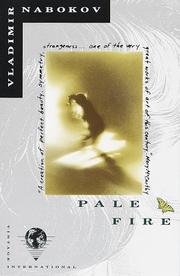 Vladimir Nabokov · 1962Pale FireLvl 9Slow burn
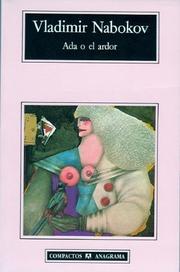 Vladimir Nabokov · 1969Ada, or Ardor: A Family ChronicleLvl 9Slow burn
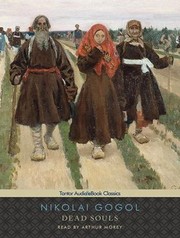 Nikolai Gogol · 1842Dead SoulsLvl 5Medium pace