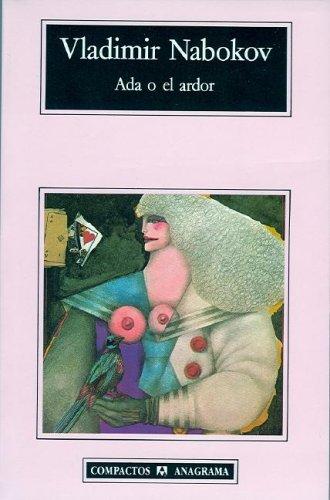
Ada, or Ardor: A Family Chronicle
Vladimir Nabokov · 1899–1977 · Russia / USA
Why it matters
A lifelong incestuous love affair unfolds across Antiterra, an alternate-history planet where Russian, French, and English bleed into one delirious language. Nabokov's longest and most extravagant novel, built as a trap for the reader's attention.
At a glance
Dense trilingual wordplay and an invented parallel world demand sustained, active decoding.
Deep dive
Nabokov invents an entire alternate planet, Antiterra, mostly so two cousins raised almost as siblings can fall in love inside a world where the rules about who's allowed to love whom have been quietly rewritten alongside everything else.
Written for readers who have finished the book. No plot recap, and nothing here is safe to read first.
Themes & symbolism
Van and Ada Veen grow up believing themselves cousins, fall for each other as children at the family estate of Ardis, and Nabokov spends the novel's opening movement building an Eden so lush and specific, orchards, insects, a whole taxonomy of the estate's summer, that the reader is fully inside the seduction before the genealogical complication, that they are actually brother and sister, their parents' affair concealed behind a cousin's cover story, arrives almost as an aside. Antiterra itself, a mirror Earth where America and Russia have merged into one hybrid civilization and electricity is banned as a mystical heresy, gives Nabokov license to bend geography, history, and language into one continuous private joke, and the forbidden nature of Van and Ada's bond reads, on this planet, less like transgression than like one more rule the two of them simply refuse to let define them.
Ada is written as Van's own old-age memoir, composed with Ada beside him annotating, correcting, and occasionally arguing with his account in the margins, so the novel's trilingual puns and anagrams, English collapsing into French collapsing into Russian mid-sentence, are staged as two people's shared, decades-long private language rather than mere ornament. Terra, a rumored other planet that maps suspiciously onto our own actual Earth, exists on Antiterra only as a fringe mystical belief, glimpsed by the mad and the dying, and Van's own psychiatric career treating patients who believe in Terra lets Nabokov fold his cosmic joke back into the plot: the world we actually live in is, to his characters, a delusion barely worth treating.
The Texture of Time, Embedded Whole
Midway through the novel, Van interrupts his own narrative to insert an entire philosophical treatise he has written, titled The Texture of Time, arguing that time has no independent flow and exists only as the mind's own act of attention. The digression stalls the plot on purpose: Nabokov wants the reader to feel time as a subject Van has spent a career failing to master, so that the treatise's dense abstraction sits directly beside the novel's most sensuous, time-drenched writing about Ardis, one register arguing against the other's evidence. Van's whole professional life as a philosopher of time reads, in retrospect, as an elaborate, scholarly detour around the one fact his own memoir keeps returning to instead: that his happiest hours were the least analyzable ones, spent simply with Ada at Ardis.
The last seal: what actually happens, and why it lands the way it does.
The ending, explained
Van and Ada's affair survives decades of forced separations, other marriages, and the slow deaths of nearly everyone around them, and the novel's last movement finds them elderly, back together, and settled into the very family memoir the reader has just finished, which turns out to be the joint work Van has been composing with Ada's corrections layered in throughout. Nabokov closes not on tragedy or exposure but on continuity: their bond was never going to be punished by Antiterra's own indifferent rules, and the couple's real triumph is simply outlasting everyone whose disapproval might have mattered, together long enough to finish writing themselves down.