
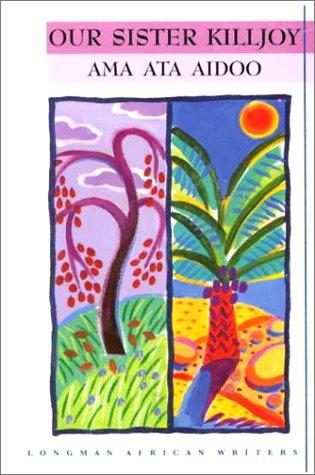
Our Sister Killjoy
Ama Ata Aidoo · 1942–2023 · Ghana
Why it matters
Sissie travels from Ghana to a German fellowship and then London, her sharp interior voice indicting European condescension and Africa's own elite complicity in one restless, genre-blurring monologue. Aidoo's most formally radical book: part novel, part poem, part letter.
At a glance
Fragmented prose-poetry sections and an unstable narrative voice resist conventional novelistic form.
Deep dive
Sissie leaves Ghana on a scholarship trip that turns into an argument with the whole idea of the African abroad, told in a form that refuses to sit still and be a novel.
Written for readers who have finished the book. No plot recap, and nothing here is safe to read first.
Themes & symbolism
Sissie's trip begins as an ordinary premise, a bright young Ghanaian on a European scholarship, and Aidoo immediately refuses to tell it in an ordinary way: prose breaks into loose verse mid-paragraph, the narrator addresses Sissie in second person as often as she narrates her in third, and long polemical passages interrupt the travel plot entirely to argue directly with the reader. The fragmentation isn't ornamental. Aidoo is working from the position that the realist novel is itself an inherited colonial form, poorly suited to a story about a woman refusing every comfortable role, hostess's favorite, grateful scholarship girl, that Europe keeps offering her, so the book's shape has to keep refusing containment along with its heroine.
In Germany, Sissie develops an intense, unresolved closeness with Marija, a lonely German housewife whose husband is largely absent and whose own life, provincial and circumscribed, turns out to have more in common with the constraints Sissie recognizes from home than either woman expects. Aidoo lets the relationship carry real erotic charge without ever letting it resolve into a named category, an ambiguity that keeps the friendship from becoming either a simple parable of cross-racial sisterhood or a straightforward romance. What the novel insists on instead is asymmetry: Sissie can leave, and does, while Marija's loneliness is a permanent condition of her own life that Sissie's visit only interrupts briefly before abandoning her to it again.
The Charge Against the Been-Tos
In London, Sissie's targets shift from a single friendship to an entire community, African students and professionals who arrived to study and quietly arranged never to leave, trading a difficult home for a foreign comfort dressed up as opportunity. Aidoo has her narrator address these 'been-tos' almost like a prosecutor, refusing the polite fiction that staying abroad is a neutral career choice rather than a continuation of the very extraction, talent leaving the continent instead of resources, that colonialism ran for a century. It's the least ambiguous section of the book precisely because Aidoo wants no ambiguity here: the novel's argument for Sissie's own eventual return is built directly against everyone in these pages who chose otherwise.
The last seal: what actually happens, and why it lands the way it does.
The ending, explained
The novel closes with 'A Love Letter,' a long, unbroken address in Sissie's voice to an unnamed 'my darling,' a former lover or a stand-in for every African she has tried and failed to persuade to come home. Aidoo lets the register shift here from polemic to something more exposed, grief and longing sitting right next to the same political argument the book has been making all along, so that the personal and the ideological stop being separable. Sissie herself has already returned to Ghana by this point, and the letter reads less like a resolution than like the argument continuing after the journey that prompted it has technically ended, refusing, true to the whole book's method, to let travel narrative settle into a tidy homecoming.
Where to go next
 Ama Ata Aidoo · 1991ChangesLvl 3Medium pace
 Chinua Achebe · 1958Things Fall ApartLvl 4Medium pace
 Ayi Kwei Armah · 1968The Beautyful Ones Are Not Yet BornLvl 6Slow burn
 Mariama Bâ · 1979So Long a LetterLvl 3Slow burn
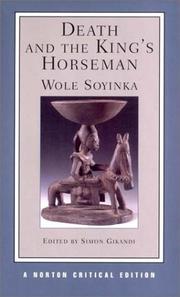 Wole Soyinka · 1975Death and the King's HorsemanLvl 6Medium pace
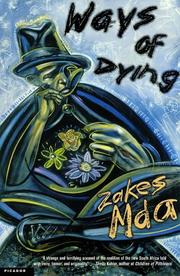 Zakes Mda · 1995Ways of DyingLvl 5Medium pace