
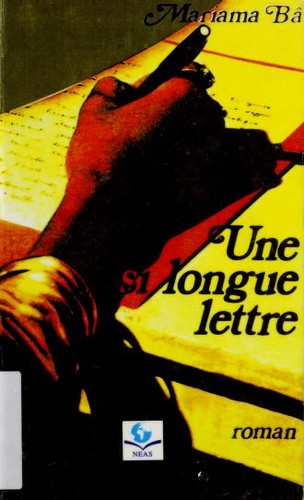
So Long a Letter
Mariama Bâ · 1929–1981 · Senegal
Originally Une si longue lettre (French) · translated by Modupé Bodé-Thomas
Why it matters
A Senegalese widow writes to her friend, reckoning with polygamy, tradition, and her own hard-won independence. Bâ's slim epistolary novel is the founding text of African women's writing: grief and quiet defiance in one voice.
At a glance
A short, intimate single-voice letter with plain, direct prose throughout.
Deep dive
Why a letter, and why now — the mourning ritual that forces Ramatoulaye's hand, and the quiet argument that restraint can be its own form of resistance.
Written for readers who have finished the book. No plot recap, and nothing here is safe to read first.
Themes & symbolism
Bâ builds the whole novel around the mirasse, the forty-day mourning confinement that traditionally silences a widow — and turns that silence inside out by making it the occasion for Ramatoulaye's most sustained act of speech. The letter is addressed to the one person who already lived the same betrayal and answered it differently, which lets Bâ stage two responses to polygamy without ranking them. Aissatou's clean break — leaving Mawdo, raising her sons alone, building a career abroad — reads as the more obviously modern choice, but the novel refuses to let Ramatoulaye's decision to stay read as capitulation. Staying costs her: reduced income, a house full of children, the daily indignity of watching Binetou's mother engineer her own daughter's marriage into the household Ramatoulaye already ran. Bâ writes that endurance as a discipline, not a failure of nerve — Ramatoulaye keeps her name, her children, and eventually her dignity, without ever pretending the marriage didn't wound her.
The generational counter-plot — Ramatoulaye's own daughter's unplanned pregnancy — is where the argument stops being implicit. Where her mother's generation would have expelled a daughter for the same transgression, Ramatoulaye responds with something closer to solidarity, folding her daughter's fumbling first steps into womanhood into the same forgiving frame she is only slowly learning to extend to herself. Tradition here isn't a wall to be escaped in one grand gesture; it's a set of expectations each generation of women pushes slightly further than the last, and the letter records that incremental push as clearly as it records grief.
Aissatou as Counter-Case
Aissatou's marriage never appears directly — it exists entirely inside Ramatoulaye's retelling, which makes it function less like a subplot than a held-up mirror. Mawdo's mother never accepts a blacksmith's daughter as fit for her son, and her campaign to unseat Aissatou reveals that the trap isn't only male: caste and class enforce the same patriarchal logic that religion and custom do, sometimes through the hands of other women. Bâ's decision to filter this entirely through her narrator's sympathetic but not uncritical eye keeps the novel from turning into a simple parable — Aissatou's exit is presented as courageous and also as a privilege Ramatoulaye, with far less education and far more children, doesn't have equal access to.
Writing as the Rescue
The epistolary form isn't incidental packaging — it's the mechanism of Ramatoulaye's recovery. Speech within the marriage was foreclosed by custom and by Modou's cowardice (he never tells her himself that he's taken a second wife); the letter restores her a register in which she controls the sequence, the emphasis, the verdict. By the final pages she isn't just reporting her decisions to Aissatou, she's making them in real time, on the page, which is why the refusals that close the book land as newly won rather than merely described.
The last seal: what actually happens, and why it lands the way it does.
The ending, explained
Custom offers Ramatoulaye two paths back into marriage: the levirate claim of Modou's brother Tamsir, who expects to inherit his brother's widow along with his house, and the sincere, decades-old devotion of Daouda Dieng. She refuses both, flatly and in her own words, choosing to finish raising her children on her own terms instead. The refusal of Tamsir is the sharper rebuke — it rejects a custom that treats widowhood as property transfer — but the refusal of Daouda, a genuinely kind man, matters more: it shows Ramatoulaye choosing solitude over even a good version of the same institution that already failed her once. The letter closes not in bitterness but in stated hope for a future of real partnership between men and women — a hope she extends despite, not because of, what she has actually lived.
Where to go next
 Assia Djebar · 1985Fantasia: An Algerian CavalcadeLvl 8Slow burn
 Tayeb Salih · 1966Season of Migration to the NorthLvl 7Slow burn
 Ama Ata Aidoo · 1991ChangesLvl 3Medium pace
 Simone de Beauvoir · 1954The MandarinsLvl 6Slow burn
 Samuel Beckett · 1951MolloyLvl 8Slow burn
 Marcel Proust · 1913Swann's WayLvl 8Slow burn