
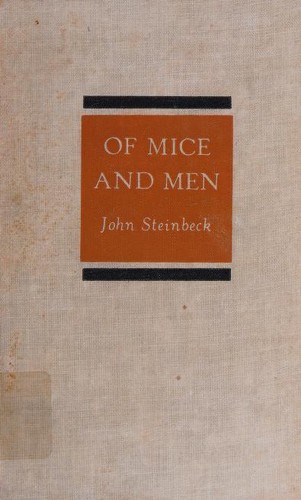
Of Mice and Men
John Steinbeck · 1902–1968 · United States
Why it matters
Two migrant workers dream of a small farm of their own, until a gentle giant's strength dooms them both. Steinbeck's tight, tragic parable of friendship and the American dream's cruelty.
At a glance
Short, plain, dialogue-driven prose makes this Steinbeck's most accessible book.
Deep dive
How George and Lennie's nightly recitation of the little farm — the rabbits, the vegetable patch — functions less like a plan than like a prayer, and what that says about who's allowed to dream out loud on this ranch.
Written for readers who have finished the book. No plot recap, and nothing here is safe to read first.
Themes & symbolism
The farm is never a real plan — George is vague about acreage, price, and location in a way he isn't vague about anything else, which tells you it's scripture, not strategy: something recited nightly to make the unbearable stretch of ranch labor bearable, for George as much as for Lennie. What makes it dangerous is that it's contagious. Candy, who's lost a hand and knows the ranch discards men the instant they're no longer useful, offers his life savings to buy in; Crooks, isolated by the color line to a room off the barn, lets himself believe for one scene before catching himself and warning Lennie off it. The men allowed anywhere near the dream are precisely the ones the migrant economy has already marked as disposable — the strong, healthy men don't need a myth about permanence and ownership, because the world already gives it to them.
Lennie's hands are the novel's most loaded image: described in animal terms, "paws," capable of crushing a man's fingers or a puppy's skull without any intention behind it, because his strength has outrun his capacity to understand consequence. He needs to touch soft things — mice, a puppy, velvet, hair — and every time the softness resists or startles, his grip becomes lethal by simple physics, not malice. Curley's crushed hand is the deliberate inversion: his violence is calculated, chosen, socially sanctioned as a boss's son's prerogative, and Steinbeck's sympathy runs entirely the other way — toward the man whose destruction is accidental in a world that has no place, and no patience, for someone who needs watching.
Curley's Wife: The Nameless Woman
She's the only character in the novella denied a name — Slim has one, Carlson has one, even Crooks and Candy exist beyond their function — reduced instead to her relation to Curley and, in the men's shorthand, to "jailbait" and "tart." But Steinbeck gives her real interiority in the one scene she's allowed to speak at length, in the barn with Lennie, where she confesses her own foreclosed dream: a talent scout's promise of Hollywood, a letter she never got, a life on the ranch she settled for out of spite and boredom rather than love. It's the same structure as George and Lennie's farm — a life-sustaining fiction about escape — except she has no George to recite it with, no one on the ranch will even let her finish a sentence without suspicion, and the novella's tragedy is doubled: her dream dies with her, and it's her one moment of being heard, by Lennie, that kills her.
The last seal: what actually happens, and why it lands the way it does.
The ending, explained
Lennie kills Curley's wife by accident in the barn, the same pattern as the puppy and the mice before her: she lets him stroke her hair, panics when he grips too hard, and his attempt to silence her screaming snaps her neck. He flees, as George long ago instructed him to do if he ever got in trouble, to the clearing by the river where the book opened. Curley assembles a lynch mob, but George gets there first, and rather than let Lennie be caught and likely tortured or killed by Curley personally, George sits beside him, has him look out across the river, and tells him the rabbit farm story one final time — the same words, the same comfort — as he raises Carlson's borrowed pistol and shoots him in the back of the head. It's a direct echo of Candy's dog, put down earlier in the book by someone else's hand while Candy sat by helplessly; George ensures Lennie isn't shown that same indignity, taking on the unbearable weight of doing it himself. The dream dies with him — there was never going to be a farm — and the closing exchange between George and Slim, walking off together while Curley and Carlson stand uncomprehending, confirms that only a few people on this ranch ever understood what the two men actually had.
Where to go next
 John Steinbeck · 1939The Grapes of WrathLvl 5Medium pace
 John Steinbeck · 1945Cannery RowLvl 3Medium pace
 John Steinbeck · 1947The PearlLvl 2Fast paced
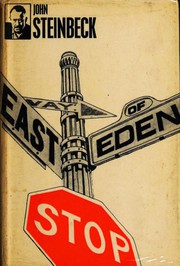 John Steinbeck · 1952East of EdenLvl 5Medium pace
 John Steinbeck · 1961The Winter of Our DiscontentLvl 5Medium pace
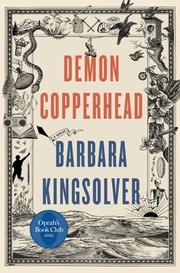 Barbara Kingsolver · 2022Demon CopperheadLvl 4Fast paced