
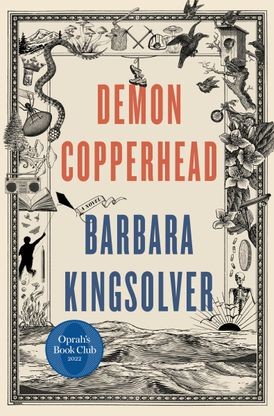
Demon Copperhead
Barbara Kingsolver · b. 1955 · USA
Why it matters
An orphaned Appalachian foster child narrates his own survival through poverty, addiction, and a child-welfare system failing him at every turn, in a novel explicitly modeled on Dickens's David Copperfield. Kingsolver's Pulitzer winner, shared with Trust, updates the orphan narrative for the opioid-crisis era.
At a glance
A propulsive, first-person vernacular voice carries a long book at an accessible pace.
Deep dive
How Kingsolver ports every major beat of David Copperfield into opioid-era Appalachia — and why renaming a villain "U-Haul" is the least of what she changes.
Written for readers who have finished the book. No plot recap, and nothing here is safe to read first.
Themes & symbolism
Kingsolver's structural fidelity to Dickens is almost devotional — an orphaned narrator, a monstrous stepfather-figure, a devoted but powerless protector, a golden charismatic friend who turns out rotten — and the fidelity is the argument: the machinery that destroys poor children hasn't changed in a century and a half, it's just swapped workhouses for the foster-care system and traded gin for OxyContin. Demon's voice, profane, funny, unsentimental even about his own worst suffering, refuses the pity that a lesser treatment of this material would invite; he narrates his own life the way he'll eventually learn to draw it, as something he controls the frame of even when he controls nothing else.
The opioid epidemic functions less as backdrop than as the novel's actual villain, distributed rather than personified — doctors, a football culture that feeds boys pills to keep them playing hurt, a pharmaceutical machine that made a fortune turning a whole region's pain into product. Demon's own mother's death, his cascading addictions, and the wreckage of nearly everyone he loves trace back to that supply chain rather than to any individual failing, and Kingsolver's insistence on tracing it that far back is the novel's clearest departure from Dickens, whose villains were at least namable, singular people.
Dickens, Relocated
The correspondences are pointed rather than cosmetic: Murdstone becomes Stoner, the violently controlling stepfather nicknamed "U-Haul" for how fast he moves in; Peggotty becomes Mr. Peg, one of the few adults who offers Demon unconditional shelter; the charismatic, doomed Steerforth becomes Fast Forward, a golden-boy football star whose glamour curdles into exploitation. Kingsolver isn't just borrowing plot, she's borrowing Dickens's own theory of the novel as social indictment, using a beloved nineteenth-century form to make a twenty-first-century American region's suffering legible to readers who'd otherwise file it under stereotype.
Drawing as Narration
Demon's talent for drawing, present from childhood and rediscovered as an adult, mirrors David Copperfield's own vocation as a writer — both are survival strategies that double as authorship, a way of insisting on a version of events that isn't the one the system of record would produce. That the novel we're reading is implicitly the verbal equivalent of Demon's sketchbook is Kingsolver's quiet case for art itself as a form of custody, the one thing nobody in Lee County can take away from him.
The last seal: what actually happens, and why it lands the way it does.
The ending, explained
Demon's path to adulthood runs through addiction, homelessness, and repeated betrayals by the systems meant to protect him, but the novel resists ending in despair. Sobriety comes hard-won rather than triumphant, anchored less in any single event than in the people who stayed — including a renewed, more honest connection with the central love interest who never stopped believing his art was worth pursuing. Kingsolver closes on a Demon who has learned to narrate his own life without either self-pity or denial, drawing rather than merely enduring the world that raised him, which is as close to a happy Dickensian ending as the material honestly allows.
Where to go next
 Barbara Kingsolver · 2009The LacunaLvl 6Slow burn
 John Steinbeck · 1937Of Mice and MenLvl 3Fast paced
 Charles Dickens · 1861Great ExpectationsLvl 4Medium pace
 Donna Tartt · 2013The GoldfinchLvl 5Fast paced
 John Irving · 1978The World According to GarpLvl 4Fast paced
 Louise Erdrich · 1984Love MedicineLvl 6Medium pace