
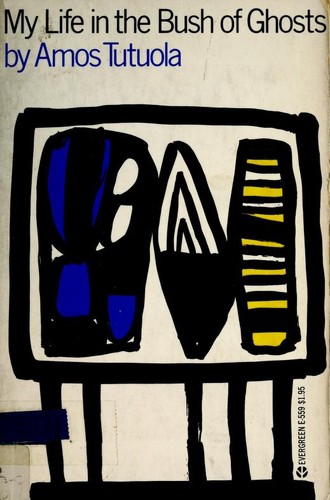
My Life in the Bush of Ghosts
Amos Tutuola · 1920–1997 · Nigeria
Why it matters
A seven-year-old boy flees into the bush and spends twenty-four years among ghosts, monsters, and shape-shifting spirits before finding his way home. Tutuola's second novel, wilder even than The Palm-Wine Drinkard, and a direct influence on the Beat generation.
At a glance
Episodic, dreamlike encounters follow folk-tale logic rather than conventional cause and effect.
Deep dive
What a seven-year-old carries out of twenty-four years spent among the dead, and why nobody, least of all Tutuola's earliest readers, could agree on whether his English was a mistake or the whole point.
Written for readers who have finished the book. No plot recap, and nothing here is safe to read first.
Themes & symbolism
The unnamed narrator's flight into the bush is not a fairy-tale departure but a documented colonial-era terror: a slave-raiding party descends on his village, and he and his older brother run for their lives before losing each other in the trees. Tutuola never lets that origin fade once the ghosts take over the narrative. Every indignity the boy suffers afterward, forced servitude to a ghost household, his body elongated and force-fed through an occult pitcher, his transformation into a cow to be sold at a ghost market, echoes the commodification he was fleeing in the first place. The Bush of Ghosts is not an escape from that violence so much as its logic pushed to a fantastical extreme: a world where a friendless child's body belongs to whoever is strong enough to claim it.
Tutuola builds his cosmology by simple accumulation rather than by argument, one town of ghosts after another, each with its own king, its own customs, its own use for the boy: the Nameless-ghost-town, the Hopeless-ghost-town, the fourth town where dilemmas are settled by riddle rather than reason, the Television-handed Ghostess who teaches him that some problems have practical remedies after all. Read end to end, the towns work less like plot than like a Yoruba oral performance transcribed onto the page, digression as method, each episode complete in itself and answerable to the ones before it only by resemblance, not by causality.
The prose itself was as contested on publication as anything in it. Tutuola wrote in an English shaped by Yoruba syntax and vocabulary rather than by any London style manual, and that friction is where the book's strangeness actually lives: ghosts with wireless-radio bellies, hills with metal doors, colonial bureaucratic titles borrowed and warped. The ghost world's refusal to resolve into a tidy shape and the English's refusal to smooth itself into familiar rhythms are the same refusal, doubled.
A Book Whose First Champion Wasn't Nigerian
Tutuola's debut, The Palm-Wine Drinkard, had already split opinion along a fault line this second book inherited directly: Dylan Thomas praised its brief, thronged, grisly and bewitching qualities in The Observer in 1952, helping build a British readership for a style some Nigerian critics dismissed as an embarrassment, broken grammar reinforcing exactly the colonial caricature of the untutored African storyteller. My Life in the Bush of Ghosts arrived two years later carrying the same argument with it. Decades on, Wole Soyinka and Chinua Achebe's generation would claim Tutuola as a genuine root of Nigerian fiction rather than its problem child, but the split over who gets to authorize what counts as literary English never fully closed, and it is still legible in how differently this book reads depending on which side of that argument a reader brings to it.
The last seal: what actually happens, and why it lands the way it does.
The ending, explained
After twenty-four years lost among the ghosts, the boy is finally shown a way out by the Television-handed Ghostess, who directs him to eat the fruit of what Tutuola calls the Future-Sign Tree before sending him back toward the human world. The homecoming is not the relief it should be. Almost immediately after his return he is captured by slave raiders again and sold to a wealthy man who, unbeknownst to either of them at first, is his own long-lost brother. He is recognized only when, being flogged for a minor offense, he cries out the words to a song the two of them sang together as children. Tutuola titles the final chapter Gladness Becomes Weeping, and means it literally: reunion arrives soaked in exactly the kind of violence the boy spent twenty-four years trying to outrun.
Where to go next
 Amos Tutuola · 1952The Palm-Wine DrinkardLvl 6Fast paced
 Chinua Achebe · 1958Things Fall ApartLvl 4Medium pace
 Wole Soyinka · 1975Death and the King's HorsemanLvl 6Medium pace
 Ama Ata Aidoo · 1991ChangesLvl 3Medium pace
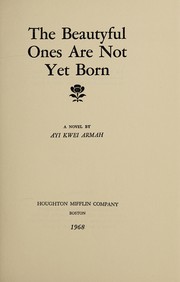 Ayi Kwei Armah · 1968The Beautyful Ones Are Not Yet BornLvl 6Slow burn
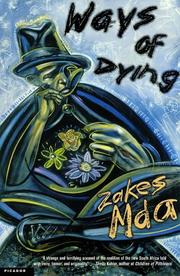 Zakes Mda · 1995Ways of DyingLvl 5Medium pace