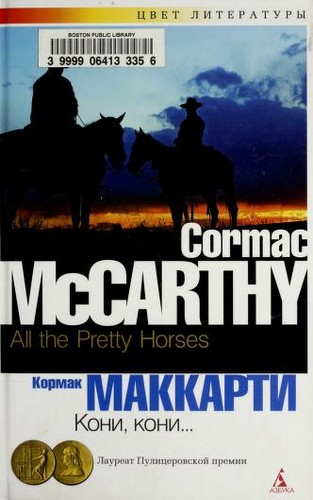
All the Pretty Horses
Cormac McCarthy · 1933–2023 · USA
Why it matters
Two Texas teenagers ride into 1949 Mexico chasing a vanishing cowboy ideal, finding love, prison, and violence instead. McCarthy's National Book Award winner brought his biblical prose into a more tender, elegiac register.
At a glance
Spare, mostly unpunctuated prose and unattributed Spanish dialogue slow readers.
Deep dive
Two Texas boys ride south chasing a cowboy code that's already dead at home — and find it's just as dead in the Mexico they were counting on to still have it.
Written for readers who have finished the book. No plot recap, and nothing here is safe to read first.
Themes & symbolism
John Grady Cole rides into Mexico because the frontier world he wants no longer exists in Texas — his family's ranch is being sold out from under him before the novel even starts, the working cattle life reduced to real estate. Mexico is supposed to be the place that world escaped to, a country lagging far enough behind modernity to still hold it; the novel's tragedy is that this is a fantasy of the American gaze, and Mexico turns out to have its own brutal, indifferent history that doesn't care what John Grady needs it to preserve for him.
His one uncorrupted arena is horses themselves — breaking the sixteen wild mares at the Hacienda is the single sequence in the book where his competence and his code function cleanly, without the moral static everywhere else. That competence buys him status with the hacendado, Rocha, but not real belonging; his romance with Rocha's daughter Alejandra crosses a class and national line the novel never lets him cross for good, and Dueña Alfonsa's long monologue on the wounds Mexican history has already dealt her family reframes his love story as a minor casualty of a much older war he never learned the terms of.
Jimmy Blevins, the reckless, half-comic boy who tags along, exists mainly to die badly — executed by corrupt rurales with no ceremony and no cowboy-story justice, shot for a horse and a pistol. His fate is the novel's flattest, coldest statement of its argument: the West's moral order, of debts repaid and courage rewarded, has no jurisdiction here, and John Grady's own near-execution and eventual release land as luck, not vindication.
The prison sequence strips the novel's romanticism down to bare survival — extortion, a knife fight, violence transacted as casually as cattle. McCarthy refuses to let this read as a detour from the 'real' story of horses and first love; it's the same Mexico, its brutality just as constitutive as the Hacienda's genteel horsemanship, and John Grady's release owes at least as much to money paid on his behalf as to any virtue of his own.
Alfonsa's History Lesson
Dueña Alfonsa's long monologue to John Grady — recounting her own youth, a lover lost to the Mexican Revolution, and her conviction that the country's history has already written the shape of individual lives before anyone gets to choose them — is the novel's clearest statement of its fatalism. She isn't simply the obstacle keeping him from Alejandra; she's evidence, drawn from her own foreclosed history, that his faith in choosing his own fate is a distinctly American delusion Mexico's actual twentieth century has no patience for.
A Prose Style Built on Refusal
McCarthy drops quotation marks, withholds interiority, and lets long stretches of Spanish dialogue sit untranslated on the page — choices that deny the English-language reader the same mastery over Mexico that John Grady himself never earns. The famously biblical cadences of the landscape descriptions sit right next to this austerity, and the friction between the two is the style's whole ethic: grandeur without sentimentality, elegy that refuses to explain itself or apologize for what it withholds.
The last seal: what actually happens, and why it lands the way it does.
The ending, explained
John Grady survives a prison stabbing, kills a man in self-defense, and rides back across the border with Alejandra's memory and little else, tracking down and recovering the horses stolen from him and Blevins along the way — restoring, at least, that one narrow debt. But Texas hasn't waited for him: his grandfather is dead, the ranch sold, the working world he set out from already gone before he set foot in Mexico. He has no station to return to and no station left in Mexico either. The novel closes with him riding on alone into unclaimed country, a rider with nowhere that wants him, the frontier's actual end enacted one last time in a single unaccompanied horseman rather than mourned in the abstract.