
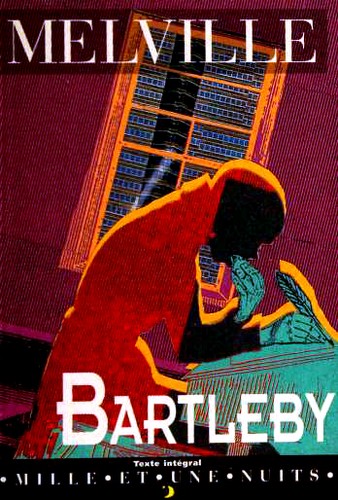
Bartleby, the Scrivener
Herman Melville · 1819–1891 · USA
Why it matters
A Wall Street copyist who 'would prefer not to,' and the phrase's quiet detonation of every office, obligation, and explanation since. The most modern story of the nineteenth century; Kafka before Kafka.
At a glance
Deceptively plain prose masks deep, unresolved ambiguity about motive and refusal.
Deep dive
A Wall Street lawyer hires a new scrivener who slowly stops doing anything at all, and the story never explains why, only how completely the refusal spreads.
Written for readers who have finished the book. No plot recap, and nothing here is safe to read first.
Themes & symbolism
The narrator, an elderly, comfortably prudent Manhattan lawyer, describes himself early as a man convinced that the easiest way of life is the best, and his entire moral vocabulary runs on charity and convenience rather than any real claim of obligation. Bartleby arrives as a new copyist, works furiously for two days, and then answers a routine request with 'I would prefer not to,' a phrase that never escalates into defiance, exactly, and never explains itself. Melville lets the refusal spread by increments, first to proofreading, then to errands, then to copying itself, then to leaving the premises at all, until the lawyer is negotiating with a man who has stopped wanting anything from the world rather than one who is fighting it. That escalation, and the lawyer's own baffled, increasingly desperate accommodations, offering raises, alternative arrangements, anything short of simply forcing him out, is the story's real comedy and horror at once: politeness proving entirely unequipped to handle a refusal with no demand attached.
Melville makes the office's architecture do real work: the lawyer's windows look out on a blank light shaft on one side and a blackened brick wall three feet away on the other, so the room is walled in even before Bartleby starts walling himself off inside it. Wall Street itself, named directly in the story's subtitle, becomes less a financial district than a landscape built entirely from dead ends and blocked views, and Bartleby's dead-ended interior life reads as the district's logical human product rather than an aberration inside it.
The Dead Letter Office
In the story's final paragraph the narrator adds an unconfirmed rumor, arriving after everything else has already happened: Bartleby once worked at the Dead Letter Office in Washington, sorting undeliverable mail for burning, bank notes and rings and forgiveness meant for people who had since died, addressed and never delivered. Melville offers this as an explanation for Bartleby's condition while explicitly refusing to confirm it, letting cause remain a rumor rather than a diagnosis. The narrator's closing cry, 'Ah, Bartleby! Ah humanity!' widens the story's despair from one strange copyist to the species generally, letters, and lives, that never reach where they were meant to go.
Melville wrote 'Bartleby' immediately after the commercial failure of Moby-Dick and the near-universal drubbing of Pierre, and he would virtually abandon fiction for magazine work and eventually a customs house job not much later. The narrator's own bewildered decency, offering raises and excuses rather than ever confronting what Bartleby actually needs, has often been read as Melville's portrait of a literary marketplace that wanted a cooperative, productive author and had no idea what to do with one who simply preferred not to keep supplying what it asked for.
The last seal: what actually happens, and why it lands the way it does.
The ending, explained
Bartleby refuses to leave the premises even after the lawyer relocates his practice entirely, and the building's new tenants eventually have him arrested as a vagrant and committed to the Tombs, Manhattan's prison. The lawyer visits, arranges for better food to be brought to him through a prison cook, and finds Bartleby has simply stopped eating, exactly as he'd earlier stopped copying and stopped moving. He's found dead days later, curled at the base of a prison wall, having refused food the same way he once refused work, his last recorded words a flat acknowledgment that he knows where he is. The story's refusals never resolve into a stated reason, only into an ending that completes the pattern one final time.
Where to go next
 Herman Melville · 1851Moby-DickLvl 8Slow burn
 Albert Camus · 1942The StrangerLvl 3Medium pace
 William Faulkner · 1930As I Lay DyingLvl 9Medium pace
 Nathaniel Hawthorne · 1850The Scarlet LetterLvl 7Slow burn
 Cormac McCarthy · 1992All the Pretty HorsesLvl 6Medium pace
 Edgar Allan Poe · 1839Selected Tales of Mystery and ImaginationLvl 6Fast paced