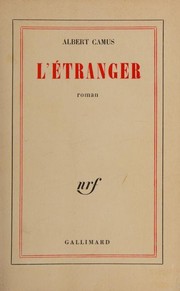
The Stranger
Albert Camus · 1913–1960 · Algeria / France
Originally L'Étranger (French)
Why it matters
Meursault kills a man on an Algerian beach and is condemned, above all, for not weeping at his mother's funeral. The century's most-read French novel: the absurd rendered in sentences of desert clarity.
At a glance
Flat, affectless short sentences; deceptively simple prose carrying philosophical weight.
Deep dive
The trial that follows the killing isn't really about the killing — it's about grief performed wrong, and what Camus's flat, present-tense prose does to make you feel the difference.
Written for readers who have finished the book. No plot recap, and nothing here is safe to read first.
Themes & symbolism
The sun. From Maman's funeral procession under a merciless white light to the beach where Meursault kills, glare and heat function as the novel's real antagonist — not fate, not evil, just the universe's blank refusal to care. The murder happens almost without agency: the Arab's knife flashes sun into Meursault's eyes, and his finger tightens on the trigger less from intent than from an assault of light and sweat he can't withstand. Camus stages the crime as something that happens to Meursault as much as something he does, which is absurdism in miniature — the world doesn't hand out reasons, and the demand that Meursault supply one is society's fiction, not the universe's.
The trial makes this explicit by inverting the actual charge. The prosecutor spends far more energy on Meursault's dry eyes at his mother's funeral, his affair with Marie the very next day, his choice to watch a comedy at the cinema, than on the shooting itself — he is condemned for failing to perform grief correctly, not for taking a life. Camus's target is the machinery by which society converts a man into a legible moral story: give the jury a monster with a coherent, hateable psychology, and the actual, causeless event underneath disappears. Meursault's crime, in the court's eyes, is honesty — his refusal to lie about feeling what he doesn't feel is what gets him guillotined.
A Style Built on Refusal
The prose enacts the absurd rather than describing it. Camus writes in short, additive clauses — "Maman died today. Or maybe yesterday, I don't know" — using the French compound past instead of the literary tense a narrator would normally use to shape a story in retrospect. The effect is a narration with no hierarchy of importance: a marriage proposal and a bus timetable get the same flat notice. Meursault doesn't rank his experiences into meaning, and neither does the sentence structure carrying them — which is exactly why his voice feels alien, and why the court cannot parse him as human.
The Unnamed Arab
The man Meursault kills is never given a name — he is "the Arab" throughout, a fact colonial-era French readers barely registered and later critics could not ignore. Kamel Daoud's 2013 novel The Meursault Investigation answers directly, narrated by the dead man's brother, finally naming him Musa and indicting the original book's silence as its own kind of violence. Camus, a pied-noir born in Algiers, wrote a novel that dismantles French bourgeois hypocrisy about death and feeling while reproducing, without comment, the era's colonial indifference to Arab life — the gap Daoud's book was written to fill.
The last seal: what actually happens, and why it lands the way it does.
The ending, explained
Waiting to be guillotined, Meursault refuses the prison chaplain's offer of God and erupts in the novel's only outburst of passion, seizing the priest by the collar and emptying out everything he actually believes: that nothing matters, that everyone is condemned to die eventually so the timing is arbitrary, that his life has been exactly as valid as any other. The rage passes, and what's left is calm — he opens himself, Camus writes, to "the gentle indifference of the world" and finds it almost like a brother. He closes the book hoping for a large, hostile crowd at his execution, greeting him with cries of hatred — not despair, but a final refusal to be alone, an absurd man wanting witnesses rather than sympathy.