
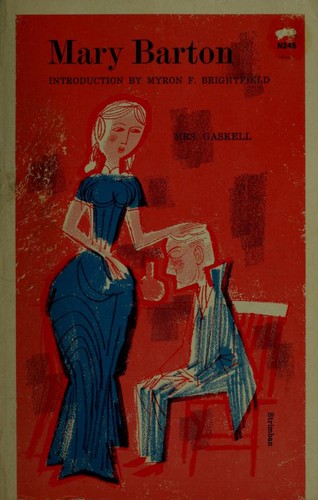
Mary Barton
Elizabeth Gaskell · 1810–1865 · England
Why it matters
A Manchester seamstress is caught between a factory owner's son and a union man amid industrial unrest and starvation wages. Gaskell's debut novel brought the 'Condition of England' question directly to fiction.
At a glance
Direct social-problem prose, occasionally slowed by dialect speech.
Deep dive
A Manchester mill hand's daughter falls for the boss's son while her father drifts toward the labor movement's most desperate act, and Gaskell forces the two plots to collide in the same courtroom.
Written for readers who have finished the book. No plot recap, and nothing here is safe to read first.
Themes & symbolism
Gaskell subtitles the novel 'A Tale of Manchester Life' and means it structurally as much as geographically: John Barton's slide from grieving widower and decent working man into a Chartist delegate and eventually an assassin is presented not as a moral failing but as the arithmetic of starvation, wage cuts, and a masters' class that treats hunger as an abstraction rather than a fact happening in the next street. The novel's opening chapters, showing the Bartons and their neighbors going without food while mill owners debate trade figures, are doing deliberate persuasive work: Gaskell wants a reader who has never missed a meal to understand exactly what pushes a reasonable man toward violence.
Mary's own plot, caught between the attentions of Henry Carson, the mill owner's son who wants her as a mistress rather than a wife, and Jem Wilson, the honest engineer she has carelessly discouraged, runs on a different register entirely, closer to sentimental romance than industrial protest, and Gaskell's decision to yoke the two together, private courtship and public class war, converging on a single murder, is the novel's most ambitious structural choice. Mary's realization that her own vanity in entertaining Carson's attention has helped set the collision in motion gives her, rather than her father, the novel's real arc: she has to grow from a girl chasing a step up in status into the person capable of saving an innocent man's life through sheer nerve.
Job Legh, the self-taught weaver who studies insects and philosophy in his spare hours, and the periodic direct addresses Gaskell makes to her presumably comfortable readers, work together to insist that the novel's poor characters possess exactly the intelligence, tenderness, and moral complexity that contemporary prejudice denied them. Gaskell was writing for an audience largely unfamiliar with, or actively hostile to, the industrial working class, and the book's sympathy is aimed less at converting Barton's employers within the story than at converting the reader holding it.
A First Novel Written Out of the Hungry Forties
Gaskell wrote Mary Barton in the aftermath of the 1842 Manchester riots and the broader hardship of the 'Hungry Forties,' years of trade depression, mass unemployment, and Chartist agitation for political representation, and she drew directly on what she witnessed as a minister's wife living among Manchester's poor. Published anonymously in 1848, the same year revolutions swept across continental Europe, the novel provoked immediate controversy: mill owners accused Gaskell of libeling their class, while some radicals felt Barton's crime was treated too harshly. That double-edged reception is itself evidence of how precisely the book landed on its historical moment, refusing either side a fully comfortable reading.
The last seal: what actually happens, and why it lands the way it does.
The ending, explained
The evidence that nearly convicts Jem, a torn scrap of wadding paper with his name on it, actually came from a gun John Barton borrowed from Jem before the murder, and Mary spends the trial's approach certain her own father is Henry Carson's actual killer. Unable to expose him, she races to track down Will Wilson, a sailor who can testify Jem was elsewhere, securing his alibi in a last-minute boat chase that saves Jem from the gallows. John Barton, wasted by guilt, eventually confesses privately to old Mr. Carson, Henry's father, who arrives intending vengeance and instead witnesses genuine remorse; the scene ends in an unlikely reconciliation. Gaskell closes by sending Mary and Jem to Canada, removing them from the Manchester that could not accommodate their happiness, a resolution that reads less as triumph than as the author's admission that the industrial city itself was not yet capable of absorbing the story's reconciliation.
Where to go next
 Elizabeth Gaskell · 1855North and SouthLvl 4Medium pace
 Anthony Trollope · 1857Barchester TowersLvl 4Medium pace
 Charlotte Brontë · 1847Jane EyreLvl 4Medium pace
 George Eliot · 1872MiddlemarchLvl 6Slow burn
 Emily Brontë · 1847Wuthering HeightsLvl 6Medium pace
 Victor Hugo · 1862Les MisérablesLvl 5Slow burn