
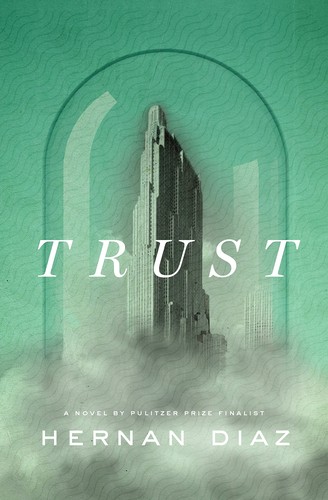
Trust
Hernán Diaz · b. 1973 · Argentina / United States
Why it matters
A Gilded Age Wall Street fortune and its enigmatic architect are narrated four separate, mutually contradicting ways (novel, memoir, ghostwriter's account, private diary), each version dismantling the credibility of the last. Diaz's Pulitzer winner, shared with Demon Copperhead, interrogates who gets to author history.
At a glance
Four nested, contradicting narrative forms require tracking whose version of events is currently in question.
Deep dive
Why the same fortune gets built four separate times by four separate authors — and what the final, quietest version finally lets its silenced woman say.
Written for readers who have finished the book. No plot recap, and nothing here is safe to read first.
Themes & symbolism
Trust's structure is its argument: a novel, a tycoon's ghostwritten memoir, a ghostwriter's own account of writing it, and finally a private diary each narrate the same Gilded Age fortune and the same marriage, and each subsequent version doesn't just add detail, it demolishes the credibility of the one before it. Diaz is staging, formally, a question usually left implicit in historical fiction: who gets custody of a life story, and what does it cost the people whose stories get told by someone else, for someone else's purposes — in this case overwhelmingly for the benefit of a man's legacy and his wealth.
The wife at the center — renamed and diminished differently across each section — spends most of the book as other people's material: a supporting character in her own husband's mythology, credited with charming eccentricity rather than the financial acumen the novel increasingly implies actually built the fortune. Money itself becomes the novel's central metaphor for narrative authority — capital, like a good story, persuades people to trust an abstraction, and Diaz keeps the parallel between market manipulation and the manipulation of historical record explicit enough that "trust" ends up meaning fortune, credulity, and a legal instrument all at once.
Four Books, One Lie
Each section doesn't merely revise the last, it exposes the material conditions of its own production — the ghostwriter recounts being hired specifically to launder the tycoon's reputation after the thinly fictionalized first version embarrassed him, and her own account, decades later, admits how much of what she wrote was invention performed on demand. Diaz builds outward suspicion into the reading experience itself: by the fourth section, readers have been trained to distrust confident narration, which is exactly the skill the book wants them to carry back into their assumptions about history generally.
Capital as Fiction
The novel keeps returning to the idea that the fortune was made partly by manipulating market perception rather than tracking real value — a rumor believed becomes a price, a price believed becomes real money — which Diaz positions as the exact mechanism by which the authorized biography operates on the wife's memory. Both money and narrative, the novel argues, run on trust extended to whoever controls the telling, and both can be counterfeited by someone with enough authority to be believed without being checked.
The last seal: what actually happens, and why it lands the way it does.
The ending, explained
The novel's final section is the wife's own diary, the first version of events not filtered through a man's authorship or ambition, and it revises nearly everything the preceding three sections implied. It restores her as the fortune's actual financial mind, the intelligence her husband's memoir had recast as charming instability, and it gives a far more painful, specific account of her illness and death than the sanitized version circulated in his authorized telling. The structural payoff is the point: after three tellings that used her as material, the book's last word finally belongs to her, unmediated, closing on the silenced author reclaiming a story that was never anyone's to tell but her own.
Where to go next
 W. G. Sebald · 1995The Rings of SaturnLvl 7Slow burn
 Orhan Pamuk · 1998My Name Is RedLvl 7Medium pace
 Roberto Bolaño · 1998The Savage DetectivesLvl 7Medium pace
 Italo Calvino · 1972Invisible CitiesLvl 5Slow burn
 Vladimir Nabokov · 1955LolitaLvl 8Medium pace
 Jorge Luis Borges · 1944FiccionesLvl 7Slow burn