
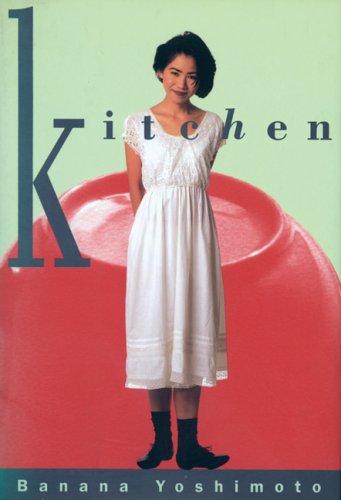
Kitchen
Banana Yoshimoto · b. 1964 · Japan
Originally Kitchen (Japanese) · translated by Megan Backus
Why it matters
A young woman finds solace in kitchens and a makeshift family after her grandmother's death. Yoshimoto's debut, a global phenomenon, made mourning and quiet healing legible to a whole generation.
At a glance
Light, plain, accessible prose aimed at a young, mainstream readership.
Deep dive
Why a novel about grief keeps returning to stoves and late-night deliveries instead of the scenes mourning usually demands.
Written for readers who have finished the book. No plot recap, and nothing here is safe to read first.
Themes & symbolism
Mikage's grief for her grandmother never gets a big cathartic scene; it gets kitchens instead — the specific, physical business of chopping, boiling, and plating as a way of staying tethered to the world when there's no family left to tether her. Yoshimoto treats domestic ritual as more trustworthy than conventional mourning, which the novel is quietly skeptical of: talking about loss, performing sadness on cue, doesn't interest Mikage nearly as much as the concrete task of feeding someone. That preference structures the whole book — home isn't a place you're born into, it's built meal by meal with whoever happens to be standing in the kitchen with you. Even Mikage's odd, recurring habit of falling asleep near refrigerators and stoves reads less as quirk than as instinct — proximity to the tools of nourishment functioning as the closest available substitute for the family she no longer has.
Eriko's household — a father who transitioned to live as a woman after his wife's death, running a nightclub and raising Yuichi alone — is presented with almost no editorializing, which is itself the point: chosen and unconventional family isn't treated as a problem to be explained but simply as where warmth happens to live. The novel never asks Mikage, or the reader, to work through surprise or judgment about Eriko's identity; it simply lets her be the warmest, most competent parent in the book, which quietly does more argumentative work than any explicit defense of the household could. When Eriko is murdered, the grief that follows echoes and compounds the loss that opened the book, and Mikage and Yuichi, now living apart, don't reach for each other through declarations. They reach through small gestures — a phone call, a shared meal, a taxi across the city — because the novel's whole argument is that this register of care, undramatic and physical, is the real one.
A generation's quiet mood
Kitchen's runaway popularity in Japan wasn't incidental to its content — readers recognized in Mikage's specific loneliness, her disconnection from conventional family structures, and her low-key, ritual-based way of coping a mood that existing literary fiction hadn't put into accessible words yet. The novel gave an entire generation of young, urban readers a vocabulary for grief and belonging that didn't require dramatic language to feel legitimate. Its spare, almost affectless prose style was part of the argument too: by refusing ornate or heightened language even at the story's most painful moments, Yoshimoto matched form to content, treating restraint itself as the appropriate register for a book about learning to keep living in small, sustainable ways rather than through cathartic release.
The last seal: what actually happens, and why it lands the way it does.
The ending, explained
After Eriko's death, Mikage, now working as a cooking assistant, senses almost telepathically that Yuichi needs her and travels a long way late at night to bring him a bowl of hot katsudon. Nothing about the scene is grand — there's no declaration of love, no formal reunion — and that's exactly what the novel has been building toward. Food, presence, and the willingness to show up with something warm to eat are treated as more real and more binding than any romantic speech could be. The ending affirms that two people without conventional family can build something like one anyway, through attention rather than announcement, and that naming the relationship further would only diminish what the gesture already proves.
Where to go next
 Sayaka Murata · 2016Convenience Store WomanLvl 2Fast paced
 Mieko Kawakami · 2019Breasts and EggsLvl 4Slow burn
 Yōko Ogawa · 1994The Memory PoliceLvl 4Slow burn
 Haruki Murakami · 1987Norwegian WoodLvl 3Fast paced
 Kenzaburō Ōe · 1964A Personal MatterLvl 5Medium pace
 Yukio Mishima · 1956The Temple of the Golden PavilionLvl 6Slow burn