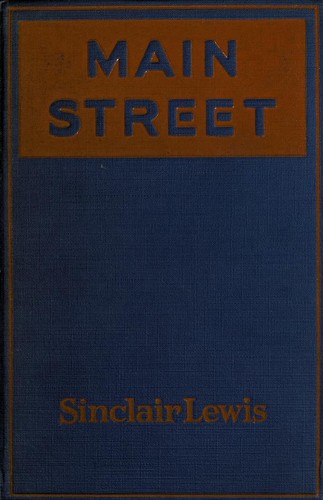
Main Street
Sinclair Lewis · 1885–1951 · United States
Why it matters
A city-bred bride moves to her husband's small Minnesota town and chafes against its suffocating provincialism. Lewis's breakout satire of small-town American self-satisfaction.
At a glance
Similarly dense satirical texture, heavy with small-town particulars.
Deep dive
Whether Carol Kennicott's crusade to civilize a Minnesota town she never wanted to live in actually changes Gopher Prairie, or just wears her down to its own size.
Written for readers who have finished the book. No plot recap, and nothing here is safe to read first.
Themes & symbolism
Carol Milford is a city-trained librarian with vague reformist ambitions when she marries small-town doctor Will Kennicott and follows him to Gopher Prairie, Minnesota, a town Lewis draws with an anthropologist's patience for its exact social machinery: the Thanatopsis Club's genteel self-congratulation, the boosters' civic pride in achievements that don't exist, the gossip network that polices every resident's smallest deviation. Carol arrives determined to modernize the place, prettier architecture, a real theater, franker conversation, and Gopher Prairie absorbs each campaign the same way: polite interest, committee formation, quiet abandonment.
Lewis coined no single word for Gopher Prairie's dynamic the way Babbitt would later name its own type, but Main Street diagnoses the same disease under a different name, what critics soon started calling the village virus, provincial self-satisfaction so total it can't recognize itself as limitation. Carol's real antagonist isn't any single character but this atmosphere itself, and Lewis is careful never to let her win a clean victory against it: her successes are small, temporary, and constantly reabsorbed into the town's larger indifference.
Miles Bjornstam, the self-declared socialist handyman the townsfolk nickname the Red Swede, is Carol's closest ally in dissent for much of the novel, and his fate underscores how much sharper Gopher Prairie's cruelty can be than its comedy suggests: after his wife and infant son die of typhoid, town gossip quietly blames his unconventional household rather than the epidemic itself, and he leaves for good, the one character in the book Lewis lets Main Street actually defeat outright.
Sauk Centre in Everything but Name
Lewis grew up in Sauk Centre, Minnesota, and Gopher Prairie reproduces its geography, institutions, and social hierarchy closely enough that the town initially took the novel as a personal insult, some residents reportedly refusing to speak to Lewis's family for years afterward. The closeness matters beyond biography: Main Street's satire works because it never invents an easy villain, only ordinary, largely well-meaning people whose collective incuriosity does more damage than any single character's malice could.
The last seal: what actually happens, and why it lands the way it does.
The ending, explained
Carol leaves Will and Gopher Prairie for two years, taking a government job in Washington during the war, and the escape gives her exactly the taste of independence she'd been craving without granting her any dramatic revelation about what to do with it. She returns to Will and the town on her own terms, not defeated exactly but recalibrated, still privately unconvinced by Gopher Prairie's values even as she resumes her place inside them. Lewis ends the novel refusing both a triumphant reform and a total surrender: Carol tells Will she still believes change is coming, someday, to someone, and the flatness of that hope is the book's last, most honest joke.