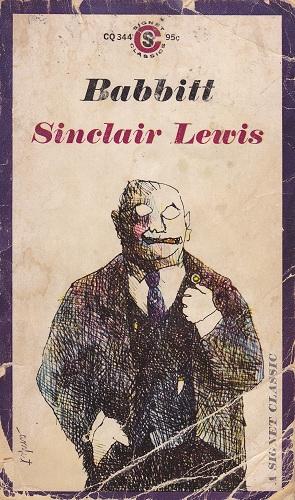
Babbitt
Sinclair Lewis · 1885–1951 · United States
Why it matters
A prosperous, conformist Midwestern realtor briefly rebels against his own respectability before settling back into it. Gave the language its word for hollow, striving American middle-class boosterism.
At a glance
Dense satirical detail and period-specific slang require attention.
Deep dive
Lewis tests exactly how far a prosperous, thoroughly respectable man can drift from his own conformity before something reels him back in — and what, if anything, survives the drift.
Written for readers who have finished the book. No plot recap, and nothing here is safe to read first.
Themes & symbolism
George F. Babbitt is a real estate broker in the fictional Midwestern city of Zenith, and Lewis's satire works by treating conformity itself as a kind of religion, complete with its own liturgy (Boosters' Club luncheons, chamber-of-commerce boilerplate, Republican Presbyterian respectability) and its own heresies (labor sympathy, adultery, skipping golf for a solitary walk). What makes the satire land harder than mere mockery is Lewis's insistence on granting Babbitt real interior life: he is ridiculous — sincerely moved by his own real-estate sales pitches, furnishing his identity out of the same standardized gadgets and slogans he sells to clients — but he's also quietly suffocating, and Lewis lets both truths sit side by side without resolving them into simple contempt.
The recurring dream of the "fairy child" — a vision of a slim, gray-eyed girl waiting for him somewhere beyond the walls of his marriage, his job, and his social calendar — is the novel's clearest symbol of everything Babbitt's respectable life has no room for: spontaneity, tenderness, an identity not assembled out of brand names and boosterism. His real affair, with the bohemian widow Tanis Judique and her loose circle of friends known as the Bunch, is Babbitt's clumsy, embarrassing attempt to live inside that dream rather than merely have it, and the novel is unsparing about how quickly he discovers that rebellion, too, has its own tedious conventions.
The Word Zenith Gave the Language
"Babbittry" entered the American vocabulary almost immediately after the novel's 1922 publication, used to describe exactly the target Lewis was aiming at: smug, conformist, small-town-minded boosterism dressed up as civic virtue and self-improvement. H. L. Mencken, the era's most influential critic, praised the novel extravagantly, and its satirical template for the standardized, marketing-saturated American suburb runs in a direct line to later chroniclers of the same territory, from John Cheever's Westchester to John Updike's Rabbit novels. In 1930, Lewis became the first American to win the Nobel Prize in Literature, and the Swedish Academy's citation named Babbitt specifically among the works establishing him as a chronicler of American life with, in the committee's words, "the art of creating, with the aid of satire that is honest and effective," a genuinely new type.
The last seal: what actually happens, and why it lands the way it does.
The ending, explained
Babbitt's rebellion doesn't end in confrontation or transformation but in illness: his wife Myra's sudden attack of appendicitis frightens him back toward the domestic and social order he'd been drifting from, fear of losing her (and fear of death generally) proving stronger than his taste for Tanis and the Bunch or his brief, tentative sympathy for a labor strike. Social pressure does the rest — friends and the Boosters' Club make plain that continued deviation will cost him business and standing, and Babbitt, offered no real alternative community to belong to, folds back into respectability without any dramatic reckoning. The novel's actual final scene shifts the possibility of rebellion onto the next generation: Babbitt's son Ted elopes with a neighbor's daughter and announces he's dropping out of college to work in a machine shop rather than pursue the law degree his parents expected. Where Babbitt braces for his own parents' role — disapproval, a lecture on respectability — he instead tells Ted privately that he's never once done what he actually wanted in his entire life, and that Ted should go ahead and do exactly what he wants. Lewis refuses Babbitt any personal epiphany or redemption; the rebellion that couldn't survive in him gets passed sideways, tentatively, to his son, and the novel ends on that small, unresolved crack rather than on any triumph or defeat.