
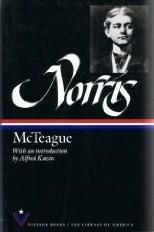
McTeague
Frank Norris · 1870–1902 · United States
Why it matters
A dim, brutish San Francisco dentist's sudden fortune curdles his marriage into obsession, violence, and a final chase into Death Valley. Zola's naturalism transplanted to America with unflinching, deterministic force.
At a glance
Naturalist detail piles up in long, deliberate descriptive passages.
Deep dive
Norris turns a mismatched Polk Street marriage into an experiment in inherited brutality, watching the thin varnish of civility wear through the moment real money enters the picture.
Written for readers who have finished the book. No plot recap, and nothing here is safe to read first.
Themes & symbolism
Norris's naturalism is explicitly biological: McTeague is introduced as a creature of "heredity" before he's introduced as a person, a hulking, slow-witted dentist whose "foul, stupid, and vicious" instincts wait beneath a placid surface like sediment, ready to be stirred. Trina undergoes the more disturbing transformation — a prim, thrifty fiancée who wins five thousand dollars in a lottery and calcifies, over the course of the novel, into a genuine miser, sleeping with her gold coins in bed and polishing them for the pleasure of touch alone. Money in this novel doesn't corrupt characters so much as it activates what was dormant in them; Norris is less interested in a fall from grace than in a slow uncovering of what was always underneath.
The recurring motifs of teeth and gilding do the book's symbolic labor: McTeague's profession, his enormous gilded tooth-shaped shop sign, and Trina's gold-hoarding all point toward civilization as a kind of dentistry — a cosmetic fix applied over something raw and animal that was never actually removed. The canary Trina keeps caged throughout the novel, chirping obliviously through domestic violence and squalor, becomes a small, mordant emblem of blind, self-enclosed appetite persisting no matter what happens around it — and Norris carries the bird all the way to the novel's final page.
Norris, Zola, and American Naturalism
Norris studied under a professor steeped in Émile Zola's fiction at Berkeley and later at Harvard, and openly modeled his ambitions on Zola's Rougon-Macquart cycle, which traced how heredity and environment determined a family's fate across generations with the supposed rigor of a laboratory experiment. McTeague is Norris's most direct transplant of that method to American soil — a plot engineered to prove a thesis about determinism rather than to follow characters wherever free will might take them. Norris died young, at thirty-two, having completed only two volumes of a planned Trilogy of the Wheat (The Octopus and The Pit) that aimed to apply the same deterministic lens to American wheat farming and market speculation, but McTeague remains his purest, most unsparing statement of naturalist doctrine.
Greed and the Novel's Afterlife
Erich von Stroheim's 1924 silent film adaptation, Greed, is now more famous among cinephiles than the novel that inspired it: Stroheim shot a version reportedly running over nine hours, intending to film nearly every scene of the book, before MGM recut it down to about two, destroying the excised footage in the process. What survives is still considered one of American silent cinema's great achievements and one of its great losses, a fittingly naturalist fate for a film about obsession and diminishment — a masterpiece ground down by the same commercial machinery it depicted.
The last seal: what actually happens, and why it lands the way it does.
The ending, explained
Once McTeague loses his practice and the couple's fortunes collapse into squalor, he murders Trina for the gold coins she's been hoarding and hiding from him, then flees California with the money, eventually drifting into the Panamint Range on the edge of Death Valley. His former friend Marcus Schouler — who set McTeague's ruin in motion out of jealousy earlier in the novel and now returns as a bounty hunter chasing the reward for his capture — tracks him into the desert. The two men fight to the death in the most punishing, dried-out landscape Norris can find, and McTeague kills Marcus, but not before Marcus manages to snap a handcuff onto McTeague's wrist, chaining himself, dead, to his killer. The novel's last image is McTeague alone in Death Valley with no water, no way to free his hand, and a corpse permanently attached to his arm — naturalism's determinism made absolutely literal, environment itself standing in as the final, wordless verdict.
Where to go next
 Frank Norris · 1901The Octopus: A Story of CaliforniaLvl 5Medium pace
 Émile Zola · 1885GerminalLvl 5Medium pace
 Theodore Dreiser · 1900Sister CarrieLvl 4Medium pace
 Upton Sinclair · 1906The JungleLvl 4Medium pace
 Władysław Reymont · 1904The PeasantsLvl 5Slow burn
 Joris-Karl Huysmans · 1884Against Nature (À rebours)Lvl 7Slow burn