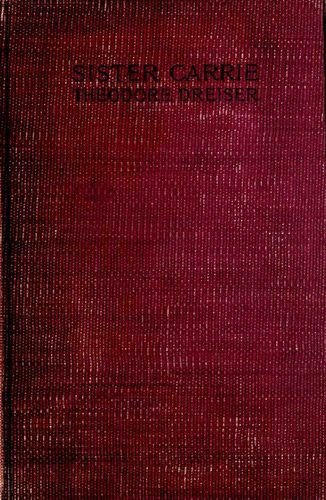
Sister Carrie
Theodore Dreiser · 1871–1945 · United States
Why it matters
A country girl rises through Chicago and New York on charm, calculation, and luck alone, unpunished by the moral reckoning Victorian convention demanded. Naturalism's blunt refusal of sentimental justice.
At a glance
Plain, accumulative prose despite its length.
Deep dive
Dreiser tracks two lives sliding in opposite directions through Chicago and New York, treating desire and ambition as forces of nature rather than moral failings to be judged.
Written for readers who have finished the book. No plot recap, and nothing here is safe to read first.
Themes & symbolism
Dreiser's great formal audacity is structural: he cross-cuts Carrie Meeber's rise against George Hurstwood's ruin so precisely that the two trajectories function as a single mechanism, one seeming almost to feed on the other. Neither is explained by conventional virtue or vice — Dreiser had absorbed Herbert Spencer's social Darwinism and treats appetite, vanity, and shame as currents that move through people rather than choices they deliberate. Carrie is porous by nature: she takes on whatever role sits nearest — shopgirl, kept woman, chorus girl, star — not through cunning but through an almost animal responsiveness to comfort and admiration wherever it's offered. Hurstwood, respectable and self-satisfied at the start, is undone by the one moment he acts on want against calculation, and everything that follows is pure entropy, a slow bleed of status, money, and will.
Material objects carry the moral weight the narrator refuses to supply: clothes, restaurant menus, hotel lobbies, and theater marquees are catalogued with real tenderness because in this world they are the actual currency of selfhood, not symbols pointing toward some deeper truth. The recurring rocking chair — Carrie rocks by her tenement window early on, dreaming of more, and rocks again in a luxury hotel suite at the close — turns a piece of furniture into the emblem of unappeasable American wanting: motion that covers no real distance, arrival that produces no contentment, just the same restless posture in ever more expensive rooms.
A Novel Too Blunt for 1900
Frank Norris, then a reader for Doubleday, championed the manuscript, but firm co-founder Frank Doubleday's wife reportedly found it morally repellent after reading it herself, and the company — having already contracted it — printed a small run while doing almost nothing to promote it. What alarmed genteel readers wasn't explicit content, of which there is essentially none, but the amorality of the plotting: a woman who transgresses respectable norms and rises anyway, unpunished and unrepentant, while the man conventionally cast as her corrupter dies alone and forgotten. Reissued properly in 1907 once Dreiser had a reputation to trade on, the novel was gradually recognized as the founding text of American literary naturalism, its flat refusal of poetic justice a direct rebuke to the sentimental fiction it was competing against on drugstore shelves.
The last seal: what actually happens, and why it lands the way it does.
The ending, explained
Hurstwood's decline is total and irreversible: fired, broke, and reduced to strikebreaking and then open panhandling, he drifts through Bowery flophouses, briefly resurfaces to beg change outside Carrie's dressing room without her ever recognizing him, and finally rents a fifteen-cent room, turns on the gas, and lies down, his last coherent thought a resigned "what's the use." Dreiser grants him no deathbed reconciliation or restored dignity — just quiet extinction, recorded as flatly as an entry in a ledger. Carrie, meanwhile, has become a celebrated Broadway actress, richer than she ever imagined in Chicago and financially independent of every man who once kept her. The novel's closing address finds her rocking alone in her hotel suite, still aching for a happiness she cannot name or locate, and insists that neither poverty nor riches was ever really the subject — the ache itself, undirected and unappeasable, is the constant. It's Dreiser's last and clearest refusal to moralize: success brings Carrie no more peace than ruin brought Hurstwood a despair he could even articulate.