
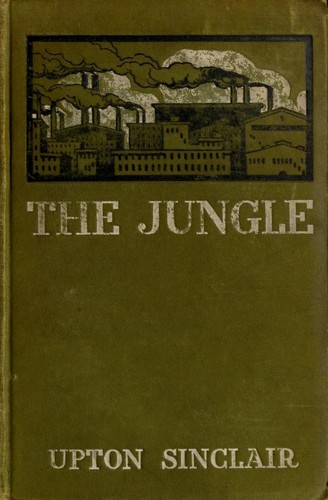
The Jungle
Upton Sinclair · 1878–1968 · United States
Why it matters
A Lithuanian immigrant family is ground down by Chicago's meatpacking industry's filth and exploitation. Written to indict capitalism, it was read as a food-safety exposé and got federal inspection laws passed within months.
At a glance
Direct, polemical prose built for persuasion, not difficulty.
Deep dive
Sinclair built a novel to radicalize readers about the exploitation of immigrant labor, and ended up as a case study in how a book's actual impact can swerve entirely away from its author's intent.
Written for readers who have finished the book. No plot recap, and nothing here is safe to read first.
Themes & symbolism
The Jungle reads, for most of its length, like naturalism at its most punishing: Jurgis Rudkus and his extended Lithuanian family arrive in Chicago with intact hopes and are dismantled one by one — cheated on a house purchase, maimed by unsafe machinery, driven into prostitution and crime, killed by workplace accidents and unattended illness — until virtually nothing of the original family survives. Sinclair's title metaphor works in both directions: the meatpacking plants are a literal jungle where human workers are processed as interchangeably as the diseased cattle and rotten meat that get shipped out for sale, and the city beyond the plants operates by the same predatory logic, red in tooth and claw, dressed up as free enterprise. The famous descriptions of adulterated food — rat-contaminated meat, poisoned rats and all, ground into sausage; the euphemistically named "potted ham" that's mostly chemical filler — are doing moral as well as literal work: contamination of the food supply mirrors the contamination of every value the family arrived with.
What sets the novel apart from the deterministic doom of Sinclair's naturalist peers is its ending's swerve into explicit political hope. Rather than closing on Jurgis's total defeat, Sinclair has him stumble into a socialist rally, and the encounter reads less like plot than like conversion narrative — a genre grafted awkwardly but sincerely onto naturalist fiction, insisting that structural horror has a structural solution rather than none at all.
The Book That Changed the Law
Sinclair wrote The Jungle as an explicitly socialist tract, spending weeks working undercover in Chicago's Packingtown to research it, and was devastated when the public reaction fixated almost entirely on the descriptions of contaminated meat rather than on the exploitation of the workers producing it. President Theodore Roosevelt, appalled, dispatched labor commissioner Charles P. Neill and social worker James Bronson Reynolds to investigate the plants; their report substantiated most of Sinclair's claims, and within months Congress passed both the Meat Inspection Act and the Pure Food and Drug Act of 1906. Sinclair's own verdict on the outcome became one of the most quoted lines in American literary history: "I aimed at the public's heart, and by accident I hit it in the stomach." The novel remains a rare case of a work of fiction directly and quickly reshaping federal regulation — just not the regulation its author was trying to write.
The last seal: what actually happens, and why it lands the way it does.
The ending, explained
By the novel's final stretch, Jurgis has lost nearly everyone: his wife Ona dies in childbirth after being effectively coerced into an affair by her boss; their infant son Antanas later drowns, unsupervised, in a flooded street; other family members die or scatter, and Jurgis himself cycles through strikebreaking, petty crime, and homelessness, each attempt at honest recovery blocked by the same systemic corruption. The turning point arrives almost by accident: soaked and aimless, he wanders into a hall where a socialist orator is speaking, and the speech lands on him like a religious conversion, giving him for the first time a framework that explains his suffering as structural rather than personal or accidental. The novel ends with Jurgis fully absorbed into the socialist movement, and its final scene is a rally erupting into chants of imminent electoral victory in Chicago — an ending pitched not at Jurgis's individual fate but at collective political transformation. Sinclair meant this as the book's emotional and ideological payoff; the fact that it reads today as the least remembered part of the novel, dwarfed by the sausage-factory horror that precedes it, is exactly the disproportion he later complained about.
Where to go next
 Upton Sinclair · 1942Dragon's TeethLvl 4Medium pace
 Émile Zola · 1885GerminalLvl 5Medium pace
 Frank Norris · 1899McTeagueLvl 5Medium pace
 Jack London · 1903The Call of the WildLvl 2Fast paced
 Stephen Crane · 1895The Red Badge of CourageLvl 5Fast paced
 Joris-Karl Huysmans · 1884Against Nature (À rebours)Lvl 7Slow burn