
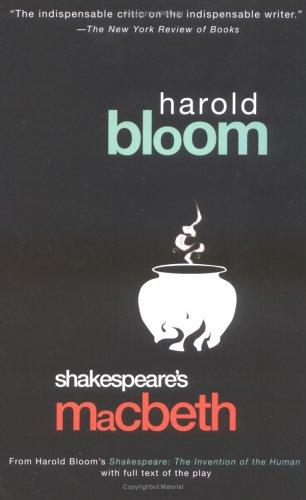
Macbeth
William Shakespeare · 1564–1616 · England
Why it matters
Three witches promise a general the crown; his wife helps him take it; guilt does the rest. Shakespeare's shortest, swiftest tragedy: ambition, murder, and conscience compressed into a nightmare that plays out at the speed of obsession.
At a glance
Brief and headlong; the compressed, hallucinatory imagery is the only real resistance.
Deep dive
Three witches hand a soldier a prophecy that requires nothing of him but ambition, and Shakespeare spends the rest of the play showing exactly how little supernatural help a man needs to destroy himself.
Written for readers who have finished the book. No plot recap, and nothing here is safe to read first.
Themes & symbolism
The witches never make Macbeth do anything. Their prophecy that he will become Thane of Cawdor and king is confirmed within minutes by a messenger, which means Shakespeare establishes their accuracy immediately and then withdraws them from the actual machinery of the plot, leaving Macbeth's own ambition, and Lady Macbeth's, to do all subsequent work. The play's moral architecture depends on that withdrawal: equivocation, not compulsion, is the witches' real weapon, and every later prophecy, that no man of woman born can harm Macbeth, that he is safe until Birnam Wood moves to Dunsinane, is technically true and practically fatal, since Macbeth hears only the comfort in each riddle and never the loophole.
Blood in the play stops meaning violence fairly early and starts meaning guilt that will not wash off, literalized in Lady Macbeth's sleepwalking scene, where she scrubs at hands only she can see stained. Shakespeare builds the imagery in both directions at once: Macbeth, before the murder, imagines his hand turning the 'multitudinous seas incarnadine,' staining the ocean rather than being cleaned by it, and that anticipatory horror turns out to be more accurate than his later, blunter denials that a little water will clear them of the deed. Guilt in this play is not a feeling that fades with success; it compounds with every subsequent killing Macbeth commits to protect the first one.
Lady Macbeth's invocation to the spirits to 'unsex' her and fill her with 'direst cruelty' reads as the play's clearest statement that ambition untethered from conscience requires actively suppressing whatever Shakespeare's Scotland coded as feminine mercy, and her subsequent collapse, guilt she cannot manage waking so it invades her sleep, punishes that suppression more thoroughly than anything that happens to her husband. Macbeth, by contrast, never successfully numbs himself the way he wants to; his soliloquies keep circling back to what he has lost, sleep, peace, honor, even as he keeps killing to protect gains that no longer feel like gains at all.
A Play Written for a King Obsessed with Witchcraft
Shakespeare wrote Macbeth around 1606, early in the reign of James I, who had come to the English throne from Scotland claiming descent from the historical Banquo and had personally authored a treatise on witchcraft, Daemonologie, after presiding over Scottish witch trials. The play's witches, its Scottish setting, and Banquo's fictional line of kings stretching to a mirror showing James's own reflection are not incidental choices but direct flattery of the new monarch's documented obsessions. That context reframes the witches' ambiguous moral status: a Jacobean audience watching alongside a king who believed in literal supernatural evil would have taken their reality, and their danger, far more seriously than a modern reader inclined to read them as psychological projection.
The last seal: what actually happens, and why it lands the way it does.
The ending, explained
Macduff, revealed to have been 'from his mother's womb untimely ripped,' delivered by what Shakespeare's era considered a form of birth that technically bypassed ordinary delivery, satisfies the prophecy's loophole and kills Macbeth in single combat, while Malcolm's soldiers, camouflaged with cut branches from Birnam Wood, fulfill the second riddle literally rather than magically. Macbeth dies still defiant, refusing to yield even after learning both prophecies have turned against him, which is the closest the play comes to admiring him: whatever else he has become, he does not die begging. Lady Macbeth is already dead by suicide, reported rather than shown, her earlier steel having curdled entirely into the sleepwalking guilt that consumed her. Malcolm's closing address restores order and promises a coronation at Scone, but Shakespeare gives the final image to Macbeth's severed head displayed on a pole, a tyrant's fate delivered exactly on schedule, with the audience left to weigh how much of the tragedy was prophecy and how much was simply two people deciding, repeatedly, to become the kind of people who could do this.
Where to go next
 William Shakespeare · 1593Richard IIILvl 6Fast paced
 William Shakespeare · 1595Romeo and JulietLvl 4Fast paced
 William Shakespeare · 1596A Midsummer Night's DreamLvl 3Fast paced
 William Shakespeare · 1601HamletLvl 6Medium pace
 William Shakespeare · 1602Twelfth NightLvl 4Fast paced
 William Shakespeare · 1603OthelloLvl 6Fast paced