
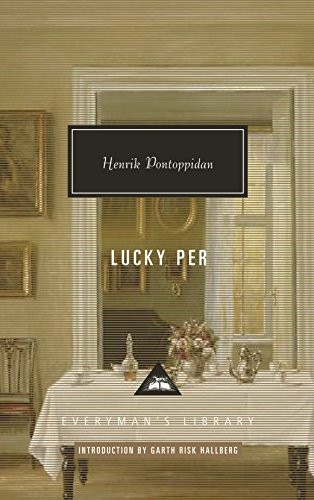
Lucky Per
Henrik Pontoppidan · 1857–1943 · Denmark
Originally Lykke-Per (Danish) · translated by Naomi Lebowitz
Why it matters
A parson's son storms Copenhagen with grand canal-building schemes, wins everything (fortune, fiancée, future) and walks away from all of it. Denmark's candidate for the great European bildungsroman, run in reverse: a self found only through renunciation.
At a glance
Long, patient, and ironic; the challenge is scale and a hero the narrator keeps at arm's length.
Deep dive
A parson's son storms Copenhagen with a grand scheme to remake Denmark's coastline, wins the city's admiration and a rich fiancée along with it, and then spends the rest of the book deciding none of it was worth having.
Written for readers who have finished the book. No plot recap, and nothing here is safe to read first.
Themes & symbolism
Per Sidenius flees his father's suffocating Jutland parsonage for Copenhagen carrying an engineer's grand, half-formed plan to harness the west coast's wind and water into a network of canals that will drag Denmark into industrial modernity, and Pontoppidan uses the scheme's technical detail, real enough to be taken seriously by the capital's engineers, to make Per's ambition legible as more than youthful bravado. The novel's title is pointed irony from the start: 'lucky' Per succeeds at exactly the things Danish society is set up to reward, and Pontoppidan spends six hundred pages asking whether that success was worth wanting.
Per's engagement to Jakobe Salomon, daughter of a wealthy, intellectually formidable Jewish Copenhagen family, offers him a marriage of genuine equals, Jakobe reads and argues with him as a partner rather than a helpmate, and represents everything modern, cosmopolitan Denmark could become if it let go of the provincial pieties Per thinks he's already escaped. That the engagement fails is the novel's real turning point, not because Per finds someone he loves more, but because some current in him keeps pulling back toward the renunciation his father's faith trained into him long before he had words for it.
Pontoppidan wrote Lucky Per as the central panel of a trilogy auditing Denmark's 'Modern Breakthrough,' and Per's arc runs the bildungsroman backward on purpose: rather than a young man finding his place in the world through struggle, Per finds it by methodically giving every worldly gain back, fortune, fiancée, professional standing, until what's left looks less like defeat than like a life finally stripped down to what he actually wanted.
Jakobe Salomon, the Engagement Denmark Almost Believed In
Jakobe is one of Danish literature's most fully realized intellectual heroines, a woman whose objections to Per's drift back toward renunciation are argued rather than simply felt, and Pontoppidan lets her walk away from him with her dignity and her convictions completely intact, marrying eventually and building a full, independent life he never manages to disturb. Thomas Mann admired the novel partly for this refusal to let Jakobe become collateral damage in Per's private reckoning with his father's God; she's the one major character the book allows to simply be right.
The last seal: what actually happens, and why it lands the way it does.
The ending, explained
Having broken the engagement, resigned his ambitions, and drifted for years, Per eventually marries Inger, a plain, devout parson's daughter who mirrors the very world he thought he'd escaped, has children with her, and then, in the novel's last movement, leaves that family too, taking a minor post as a district road engineer in the Jutland heath his father once preached over. He dies there in a self-imposed solitude, leaving behind a testament explaining that he came, in the end, to see his father's discipline of renunciation as the one durable thing worth having, a conclusion the novel presents without either endorsing or mocking it, Pontoppidan's own famous refusal to hand his hero a verdict.
Where to go next
 Leopoldo Alas "Clarín" · 1885La RegentaLvl 6Slow burn
 Pío Baroja · 1911The Tree of KnowledgeLvl 5Medium pace
 Guy de Maupassant · 1885Bel-AmiLvl 4Medium pace
 Kate Chopin · 1899The AwakeningLvl 5Medium pace
 Thomas Hardy · 1891Tess of the d'UrbervillesLvl 4Medium pace
 Gabriele D'Annunzio · 1889The Child of PleasureLvl 6Slow burn