
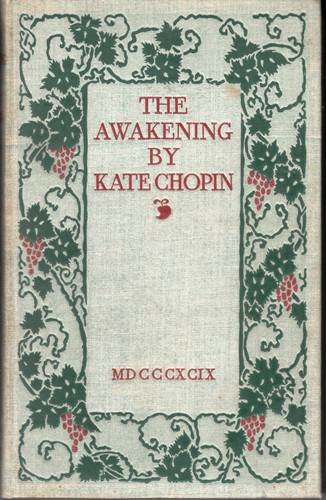
The Awakening
Kate Chopin · 1850–1904 · United States
Why it matters
A Louisiana wife and mother discovers desires (artistic, sexual, existential) that her marriage and society cannot accommodate. Denounced as immoral on publication, later reclaimed as an early landmark of feminist fiction.
At a glance
Spare prose carries considerable symbolic and emotional weight.
Deep dive
Chopin gives her heroine an awakening on three fronts at once — aesthetic, sexual, and metaphysical — and refuses to say which one costs her the most.
Written for readers who have finished the book. No plot recap, and nothing here is safe to read first.
Themes & symbolism
The sea is the novel's controlling image from its first pages, described in language that fuses eroticism and death: it 'speaks to the soul,' inviting it to wander 'in abysses of solitude,' and Edna's swimming lessons are staged as a seduction before they're anything else. Chopin pairs this with bird imagery — the caged parrot and mockingbird squawking in a language no one understands at the Grand Isle pension, Mademoiselle Reisz's blunt warning that the artist who would soar 'above the level of tradition and prejudice' needs 'strong wings,' and must be prepared to see the weaklings fall, bruised and exhausted, back to earth. Edna never gets her strong wings; she gets glimpses of freedom — painting seriously, taking a lover, moving into her own 'pigeon house' — without ever finding a structure that can hold an awakened self inside a marriage built on the opposite premise.
Chopin sets Edna against two women who represent the available scripts she can't quite occupy. Adèle Ratignolle is the 'mother-woman' ideal, folding herself entirely into husband and children with a completeness Edna finds both moving and suffocating; Mademoiselle Reisz is the alternative — solitary, unlovely, uncompromising, an artist who has traded domestic warmth for total independence. Edna wants neither bargain and both at once, which is precisely the position the novel insists Creole Louisiana in 1899 has no room for. Robert's flight rather than scandal, and Arobin's frank appetite without commitment, aren't failures of romance so much as demonstrations that even the men who desire Edna can't imagine a life built around her desire rather than their own comfort.
Scandal, Silence, and Rediscovery
On publication, The Awakening was received less as literature than as a moral emergency: reviewers called it 'poison,' 'unhealthy,' morbid and unwholesome, and objected less to Edna's adultery than to the book's refusal to punish her for wanting it in the first place. St. Louis society, where Chopin lived, largely closed ranks against her; libraries pulled the book, a literary club reportedly withdrew her membership, and the novel's failure effectively ended her career — she published only a handful of stories before her death five years later, a silencing that mirrors, uncomfortably, Edna's own. The book was allowed to go out of print and stayed there for decades, a footnote in American literature classified alongside minor local-color fiction.
Its rehabilitation came from outside the American academy first — a Norwegian scholar, Per Seyersted, produced the critical biography that relaunched Chopin's reputation in 1969, arriving just as second-wave feminist critics were hunting for exactly this kind of text: a woman's interiority taken with total seriousness, unresolved and unapologetic. It's now taught constantly alongside Madame Bovary, not as an imitation of Flaubert but as an American answer to the same question — what happens to a woman whose imagination outgrows the plot her society has written for her — with the crucial difference that Chopin lets Edna's desires include art and selfhood, not only romance.
The last seal: what actually happens, and why it lands the way it does.
The ending, explained
Having lost Robert — who leaves a note rather than let their affair become the scandal it would need to be to survive — and having just sat with Adèle through a difficult childbirth that reasserts, in the most physical terms possible, exactly what marriage and motherhood cost a woman, Edna returns alone to Grand Isle. She takes off her clothes and swims out into the Gulf, past the point of exhaustion, her mind drifting to the terror of childhood and the hum of bees and scent of pinks in a meadow she once crossed 'thinking she would never reach the end of it.' Chopin gives no verdict: the swim reads simultaneously as suicide, as defeat by a society that offered Edna no viable place to be fully herself, and as the one unqualified act of self-possession available to her — total, silent, on her own terms, answerable to no one. The ambiguity is the point; the novel that scandalized readers for refusing to moralize Edna's affairs refuses, just as pointedly, to moralize her ending.
Where to go next
 Gustave Flaubert · 1857Madame BovaryLvl 5Slow burn
 Guy de Maupassant · 1885Bel-AmiLvl 4Medium pace
 Leopoldo Alas "Clarín" · 1885La RegentaLvl 6Slow burn
 Theodore Dreiser · 1900Sister CarrieLvl 4Medium pace
 Émile Zola · 1885GerminalLvl 5Medium pace
 Joris-Karl Huysmans · 1884Against Nature (À rebours)Lvl 7Slow burn