
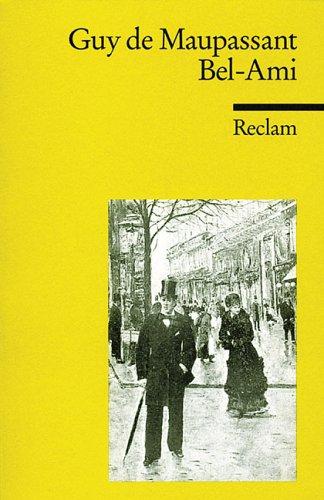
Bel-Ami
Guy de Maupassant · 1850–1893 · France
Originally Bel-Ami (French)
Why it matters
An unscrupulous ex-soldier claws his way up Parisian journalism and society by seducing the women who can help him. Maupassant's Flaubertian precision applied to pure, glittering cynicism about ambition.
At a glance
Clear Flaubertian sentences; the difficulty is moral, not stylistic.
Deep dive
A penniless ex-soldier sleeps his way to the top of Parisian journalism, and Maupassant never once lets him feel a flicker of guilt about it.
Written for readers who have finished the book. No plot recap, and nothing here is safe to read first.
Themes & symbolism
Georges Duroy's rise from a broke former colonial soldier to the wealthy, influential 'Bel-Ami' of Parisian high society is engineered entirely through women — Madeleine Forestier's writing talent, Clotilde de Marelle's money and connections, Virginie Walter's infatuation and eventually her own daughter Suzanne's fortune — and Maupassant structures the novel as an unbroken chain of exploitation in which Duroy discards each woman precisely at the moment she's finished serving his advancement, without the narrative ever pausing to moralize or supply him a redemptive crisis of conscience.
The Parisian press, the arena where Duroy makes his name, is exposed throughout as a machine for manufacturing convenient truth: articles are ghostwritten, political and financial interests dictate editorial line (the newspaper La Vie Française runs on colonial stock speculation its own editor is secretly profiting from), and Duroy's own journalistic 'talent' amounts mostly to Madeleine's uncredited prose polished under his byline — Maupassant's flat, precise style refuses melodrama here, presenting institutional corruption as simply how the business works rather than as scandal requiring exposure.
Duroy's physical vanity and his repeated appraisal of his own reflection in mirrors across the novel isn't incidental characterization; Maupassant uses it to establish Duroy as a man who has correctly identified that in this Paris, charm and physical attractiveness function as convertible capital exactly like money or a title does, and the novel's amorality lies in refusing to punish him for correctly reading his environment — Duroy isn't a monster breaking the rules, he's simply the character most willing to play the game everyone else is already playing, without any of their residual squeamishness.
Maupassant's Flaubertian Cynicism
Trained and mentored directly by Gustave Flaubert, Maupassant brought the same clear, unadorned realist prose and refusal of authorial moralizing to Bel-Ami that Flaubert had applied to Emma Bovary, but aimed it at a male social climber allowed to succeed rather than a female adulteress required to be punished — a deliberate asymmetry contemporary and later critics have read as Maupassant's own bleak commentary on the different rules governing ambition and desire by gender in Third Republic France. Drawing on his own years working in Parisian journalism, Maupassant wrote the novel with an insider's specificity about how newspapers, stock tips, and social advancement actually intertwined, giving the satire a documentary precision beneath its cynicism.
The last seal: what actually happens, and why it lands the way it does.
The ending, explained
Having divorced Madeleine after catching her in an affair (itself a calculated maneuver, since French law let the injured party keep more marital property), Duroy seduces and elopes with the teenage Suzanne Walter, daughter of his own newspaper's proprietor, forcing her parents to accept a marriage they have no way to prevent once elopement makes refusal a public scandal. The final scene stages the wedding at the Church of the Madeleine in triumphant, almost operatic terms — Duroy surveying Parisian society, briefly locking eyes with Clotilde, the discarded mistress who still can't resist him, before stepping into sunlight a made man, wealthy, respectably married, and utterly unpunished. Maupassant's refusal of any comeuppance is the point: the novel closes not on justice but on confirmation that this Paris really does reward exactly this kind of man, and will keep doing so.
Where to go next
 Guy de Maupassant · 1888Pierre and JeanLvl 4Medium pace
 Gustave Flaubert · 1857Madame BovaryLvl 5Slow burn
 Émile Zola · 1885GerminalLvl 5Medium pace
 Leopoldo Alas "Clarín" · 1885La RegentaLvl 6Slow burn
 Joris-Karl Huysmans · 1884Against Nature (À rebours)Lvl 7Slow burn
 Kate Chopin · 1899The AwakeningLvl 5Medium pace