
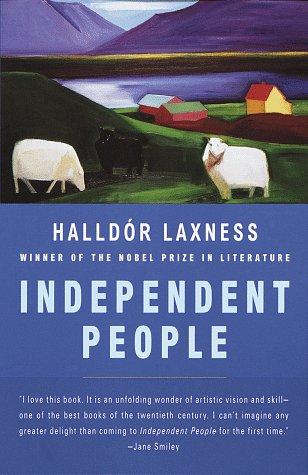
Independent People
Halldór Laxness · 1902–1998 · Iceland
Originally Sjálfstætt fólk (Icelandic)
Why it matters
A stubborn Icelandic sheep farmer sacrifices everyone he loves to his dream of owing nothing to anyone. Laxness's saga-inflected tragicomedy of pride and poverty on the volcanic edge of Europe.
At a glance
Deadpan irony beneath punishing rural hardship, sustained across an epic span.
Deep dive
A saga hero's stubborn self-sufficiency, played completely straight by the man living it and diagnosed as a disease by everyone standing near him.
Written for readers who have finished the book. No plot recap, and nothing here is safe to read first.
Themes & symbolism
Bjartur spends eighteen years as a servant before buying his own croft and renaming it Summerhouses, defying its old, cursed name — his refusal of debt, cooperative aid, or dependence of any kind is framed at first as saga-hero stoicism, then gradually revealed as a pride that costs him nearly everyone he's responsible for. His first wife, Rosa, dies effectively alone in childbirth while he's away retrieving a ram, prioritizing livestock over his own wife without apparent hesitation — the clearest single image the novel offers of what his ideology of independence actually protects, and what it doesn't.
Asta Sollilja, raised as his daughter though implied not to be his by blood, receives the novel's most tender and most damaged attention: he loves her most and fails her worst, casting her out once he learns she's pregnant, the same rigid honor code that built his independence turned as cruelty against the one relationship that might have redeemed it. Laxness uses her to measure what Bjartur's doctrine actually costs — not himself, who thrives on hardship as a point of pride, but the women and children required to live inside a philosophy built for a man entirely alone.
The sheep themselves function as a running ironic counterweight to Bjartur's human relationships throughout — he names them, worries over their health with a tenderness he rarely extends to his own family, and treats a lost or sick ewe as a graver emergency than a sick child. Laxness never states the comparison outright; he simply lets the reader notice, scene after scene, that the independence Bjartur prizes is really independence from people specifically, since he remains entirely, willingly dependent on the flock he's built his whole identity around protecting.
Socialist Critique in Saga Clothing
Laxness borrows the terse, ironic understatement of the Icelandic sagas while arguing against everything the sagas typically celebrate, turning Bjartur's cooperative-averse individualism into a critique of both romantic nationalism and the free-market ideology Laxness associated with Iceland's landowning class. His own leftist politics of the 1930s are legible throughout without collapsing the book into a tract, because Bjartur himself remains genuinely, tragically compelling rather than a strawman built to lose the argument.
The last seal: what actually happens, and why it lands the way it does.
The ending, explained
After losing Summerhouses to debt and a run of bad luck he refuses to blame on anything but fate, Bjartur is left with almost nothing. In the final pages he reconciles with the aging, ailing Asta Sollilja, who now has an illegitimate child of her own, and the two of them set out together with her child toward a new, uncertain settlement — still refusing charity, still calling himself independent even with everything material stripped away. The narrator's closing gloss, comparing him to a man who spent his whole life sowing his enemy's field, reframes his entire ideology as a kind of unwitting self-sacrifice to forces — debt, markets, landowners — he never let himself see clearly enough to actually resist.
Where to go next
 Halldór Laxness · 1957The Fish Can SingLvl 4Medium pace
 Selma Lagerlöf · 1891Gösta Berling's SagaLvl 6Medium pace
 Sigrid Undset · 1920Kristin LavransdatterLvl 6Slow burn
 Frans Eemil Sillanpää · 1931The Maid SiljaLvl 4Medium pace
 Knut Hamsun · 1890HungerLvl 5Medium pace
 Elsa Morante · 1974History: A NovelLvl 5Medium pace