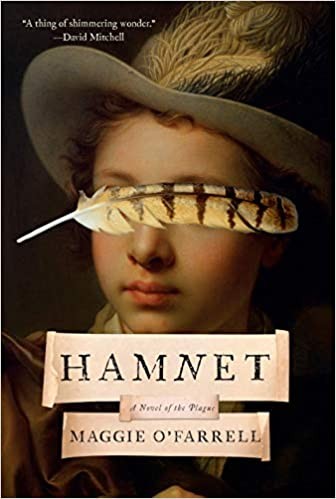
Hamnet
Maggie O'Farrell · b. 1972 · United Kingdom
Why it matters
Agnes Hathaway loses her eleven-year-old son Hamnet to plague in 1596, years before her husband, an unnamed Latin tutor turned London playwright, writes Hamlet. A speculative, emotionally devastating account of the private grief inside a very public afterlife.
At a glance
A dual timeline and intensely close attention to grief ask for unhurried, attentive reading.
Deep dive
A plague takes an eleven-year-old boy in Stratford while his father is away in London, and the novel asks what a parent's grief looks like years before anyone in the house knows that grief will end up with the boy's name on a stage.
Written for readers who have finished the book. No plot recap, and nothing here is safe to read first.
Themes & symbolism
O'Farrell keeps Shakespeare almost entirely unnamed, referred to only as the Latin tutor, the husband, the father, a choice that relocates the novel's center of gravity away from literary history and onto Agnes, the falconer's daughter with a reputation for second sight who marries him against her stepmother's wishes. The decision reads as a corrective: four centuries of scholarship have asked what Hamnet's death meant for the writing of Hamlet, and O'Farrell asks instead what his death meant inside the house where his mother and twin sister actually lived through it, a question Shakespeare studies has almost never bothered to put first.
Agnes's beekeeping, her knowledge of herbs, her ability to read a person's future by gripping the flesh between their thumb and forefinger, mark her from the novel's opening pages as someone attuned to forces the rational Stratford around her doesn't credit, which makes the central irony land harder: for all her gift at foreseeing others' fates, she reads her own children's illness backward, certain the frailer twin Judith is the one in danger until Hamnet is the one who dies. The novel treats that misreading not as a failure of her power but as the one blind spot built into loving your own children too specifically to see them clearly.
The novel's structure alternates Hamnet's final day, tracked almost hour by hour as the plague fever takes hold, against the deeper past of Agnes and her husband's courtship, a braid that forces the reader to hold the boy's death and his parents' falling in love in the same span of attention. A standalone chapter tracing the flea that likely carried the plague from a Venetian glassblower's monkey through months of cargo and coastline before it ever reaches Warwickshire turns the infection into its own epic, indifferent to the family it's about to devastate.
A Cover That Refuses to Name Him
O'Farrell has said in interviews that Hamnet and Hamlet were, in the parish records of the period, functionally the same name, used interchangeably for the same child, which strips away the scholarly hedging around whether the play is 'about' the son and replaces it with something closer to certainty: a father wrote his dead boy's name onto the biggest stage in London four years after burying him. The novel never states outright why he did it, leaving that question for the reader to sit with exactly as unresolved as it is in the historical record.
The last seal: what actually happens, and why it lands the way it does.
The ending, explained
Years after Hamnet's death, Agnes learns that her husband has written a play using their son's name for its title and travels to London, furious, believing he has turned their private grief into a commercial spectacle without her consent. Watching the performance, she sees the actor playing the ghost, her husband himself, speak the name aloud again and again as the murdered king demanding remembrance, and understands the play not as exploitation but as the closest thing to a resurrection either of them will ever manage: a boy who cannot be brought back is instead made to speak, endlessly, every time the play is performed. The reconciliation is unspoken, carried entirely in Agnes watching her husband's grief finally surface in the one language he has ever fully trusted.