
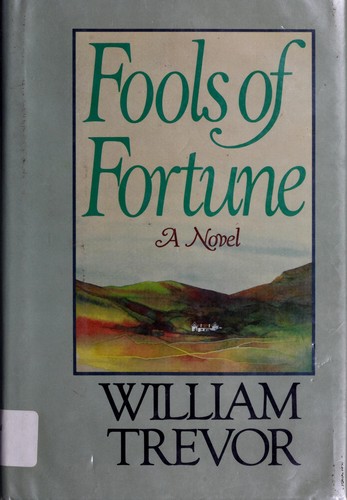
Fools of Fortune
William Trevor · 1928–2016 · Ireland
Why it matters
A single act of Troubles-era violence shatters an Anglo-Irish family across three generations, love and vengeance passed down like an inheritance nobody asked for. Trevor's finest novel proves history in Ireland is never over, only re-inherited.
At a glance
Clear, restrained prose; the difficulty is emotional rather than structural.
Deep dive
One Troubles-era atrocity at a family's country house ripples through three generations of Anglo-Irish descendants, love and reprisal both passed down like property nobody chose to inherit.
Written for readers who have finished the book. No plot recap, and nothing here is safe to read first.
Themes & symbolism
Trevor structures the novel so that the Black and Tans' burning of Kilneagh, and the killing of Willie's father, sisters, and staff in retaliation for suspected republican sympathy, never functions as a single, containable historical event; instead it becomes the family's actual inheritance, more binding than the house or the land, mutating as it passes hand to hand. Willie's mother cannot metabolize the grief and drinks herself toward her own end; Willie himself absorbs the loss as an obligation rather than a wound, and years later tracks down and kills Rudkin, the specific British officer responsible, an act of vengeance the novel refuses to treat as justice or catharsis, showing instead that it simply adds a second ruin, Willie's own exile and effective disappearance from ordinary life, on top of the first, without restoring anything the family actually lost.
The novel's real argument is carried by the women left holding what the men's actions produced: Marianne, pregnant after her brief reunion with Willie before he vanishes into consequence, raises their daughter Imelda largely alone on fragments and euphemisms rather than the full story, and Imelda grows up inside a house where the past is everywhere and explained nowhere. That half-telling is its own form of violence, passed down as surely as the original atrocity: Imelda inherits an unprocessed history she's never equipped to make sense of, and Trevor's bleak final suggestion is that in this particular Ireland, trauma doesn't require direct experience to be transmitted, only proximity and silence.
A Novel Told in Two Incomplete Griefs
Trevor tells the story in alternating first-person sections, Willie's and Marianne's, that don't so much complete each other as demonstrate how incompletely any single witness, even a devoted one, can hold a family's history: Marianne knows fragments Willie doesn't, and vice versa, and neither ever gets access to Imelda's interior consciousness at all, which arrives only through what the adults around her intuit and describe. That formal gap, a life the novel builds every event toward but is never allowed to narrate from the inside, mirrors exactly what happens to Imelda within the story, an inheritor kept outside the very history that will define her, and it's why the novel's quiet rendering of her final retreat lands as inevitable rather than as a twist.
The last seal: what actually happens, and why it lands the way it does.
The ending, explained
Piecing together enough fragments of her family's violent history to sense its shape without ever being given the whole of it plainly, Imelda retreats from what she can't fully process into a private, protective unreality, imagining she can still see and sit with her long-absent father as though he'd never left. It isn't presented as a dramatic breakdown so much as a quiet, permanent withdrawal, the family's final and least willed inheritance: neither Willie's act of vengeance nor his mother's earlier collapse actually settled anything, and the violence that began at Kilneagh simply finds, three generations on, a new person too young to have chosen any of it to live inside. Trevor's closing image insists that in this history there's no generation whose action, whether revenge, grief, or silence, finally closes the account; there's only the next inheritor.
Where to go next
 Yiyun Li · 2009The VagrantsLvl 6Slow burn
 Anton Chekhov · 1899Selected StoriesLvl 4Medium pace
 Richard Yates · 1961Revolutionary RoadLvl 4Medium pace
 Ludmila Ulitskaya · 2010The Big Green TentLvl 5Medium pace
 Maggie O'Farrell · 2020HamnetLvl 5Medium pace
 Peter Taylor · 1986A Summons to MemphisLvl 5Slow burn