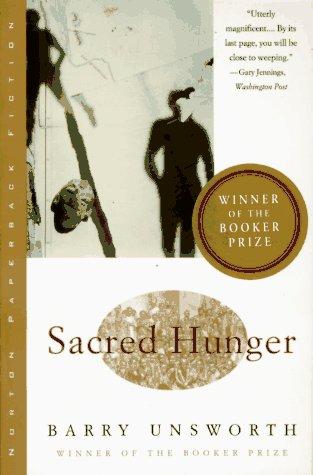
Sacred Hunger
Barry Unsworth · 1930–2012 · England
Why it matters
A Liverpool slave ship's idealistic surgeon and its owner's ruthless son confront the 1750s Atlantic trade's brutality firsthand, and the mutinous survivors' escaped-community experiment collapses under the same greed it fled. Unsworth's meticulously researched novel shared the Booker Prize.
At a glance
Dense period detail and a sprawling cast trace the slave trade's machinery across two continents.
Deep dive
Why Unsworth builds a mutinous crew's escaped settlement in the Florida swamps as a direct rebuttal to the slave ship's economics — and what its own internal fractures say about his real target.
Written for readers who have finished the book. No plot recap, and nothing here is safe to read first.
Themes & symbolism
Unsworth splits his moral argument between two cousins: Matthew Paris, the idealistic ship's surgeon disgraced by his abolitionist sympathies before the voyage even begins, and Erasmus Kemp, the owner's son whose humiliations — romantic and financial — curdle into a lifelong project of vengeance and accumulation. The title's "sacred hunger" is Erasmus's father's own phrase for the profit motive dressed up as providence, and the novel spends its length demonstrating that the phrase is not hypocrisy so much as sincere theology: eighteenth-century mercantile Liverpool genuinely believed acquisition was a form of grace, which is what makes the trade's brutality — chained bodies calculated by the day's going insurance rates — so chillingly procedural rather than merely cruel.
The Liverpool Merchant's mutiny and the founding of the mixed-race community in the Florida swamps stage the novel's utopian counter-argument: enslaved Africans, sailors, and Paris himself build an improvised society without hierarchy, without ownership, functioning for over a decade on principles the ship's economy explicitly denied. That the community reproduces some of the same status anxieties and small betrayals as the world it fled is Unsworth's most unsentimental move — he refuses to let the escaped settlement stand as an uncomplicated redemption, insisting instead that greed and hierarchy are standing temptations for any human arrangement, not just the slave trade's specific evil.
Erasmus Kemp as the Engine of History
Unsworth gives Erasmus's decades-long pursuit of the Liverpool Merchant's mutineers a psychological engine as much economic as personal — his father's ruin and suicide after the ship's disappearance leave him needing the loss recouped and the humiliation avenged in equal measure. That the novel lets his obsessive, patient capitalism eventually win, hunting down and destroying the one community that tried to build something outside its logic, is the book's bleakest and most historically honest choice: in the actual eighteenth-century Atlantic world, capital accumulation reliably outlasted utopian experiment.
Research as Moral Weight
Unsworth's reconstruction of the Middle Passage draws on the documented economics of the slave trade in granular, unglamorous detail — insurance claims, cargo manifests, the exact calculus by which a dying captive became a write-off rather than a person — and that archival density is doing deliberate ideological work. By refusing melodrama and instead letting the trade's bureaucratic ordinariness speak for itself, the novel indicts a system that operated, disturbingly, without needing anyone involved to think of themselves as monstrous, only as men doing sound business.
The last seal: what actually happens, and why it lands the way it does.
The ending, explained
Years after the mutiny, Erasmus Kemp finally tracks down the survivors' hidden settlement in the Florida swamps, and the discovery ends the community exactly as its members always feared it would: settlers and former captives alike are recaptured, sold back into slavery, or scattered, the fragile experiment in living outside ownership and hierarchy dismantled by the same commercial machinery it had escaped. Unsworth declines to grant it a heroic last stand; the destruction is procedural, almost bureaucratic, in keeping with the novel's insistence that the slave trade's violence was administrative before it was ever personal. Erasmus gets his restitution, such as it is, but the novel's sympathies have long since made clear that his victory is the book's tragedy, not its justice.