
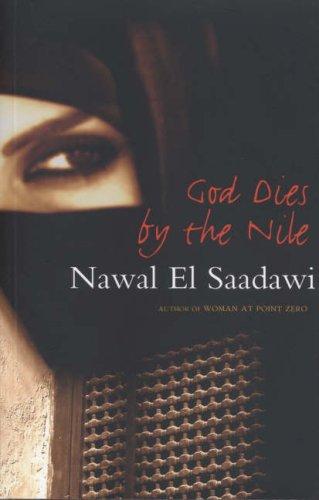
God Dies by the Nile
Nawal El Saadawi · 1931–2021 · Egypt
Originally Mawt al-Rajul al-Wahid ala al-Ard (Arabic) · translated by Sherif Hetata
Why it matters
A village mayor's abuse of three generations of one family builds toward a reckoning years in the making, patriarchal and state power revealed as the same machine. El Saadawi's fiercest indictment of rural Egypt's compounding oppressions.
At a glance
A tightly wound village tragedy narrated with blunt, escalating directness.
Deep dive
The title's promise sits right on the cover, so the real question the book is asking is not what eventually happens to the Mayor, it is how an entire village's men made it look inevitable first.
Written for readers who have finished the book. No plot recap, and nothing here is safe to read first.
Themes & symbolism
Zakeya's life is organized entirely around forced, unpaid labor in the Mayor's fields, and around watching her nieces Zeinab and Nefissa fall, one after another, into the same man's reach. El Saadawi builds the abuse as a system rather than an aberration: the Mayor, the imam Sheikh Hamzawi, and the head of the village guard each cite a different authority, land, religion, order, to justify extraction from the same powerless households, and each one's authority quietly depends on the other two never questioning it.
The prose moves in the same flat, repetitive rhythms as the labor it describes, planting, watering, harvesting, rendered with a ritual sameness that mimics how completely the village's oppression has become simply the shape of daily life rather than an event anyone could point to and call unjust. Zakeya's eventual break with that rhythm, read by everyone around her as madness, is the novel's clearest argument that madness may be the only sane response left to a woman who has watched every institution meant to protect her family instead consume it.
Zeinab's arc runs alongside Nefissa's as a second case study in the same machinery: the Mayor pursues her too, and when her husband Galal is arrested by the Mayor's allies on charges that exist mainly to remove him from her life, El Saadawi shows how easily the machinery of local law enforcement converts a rival's inconvenience into a criminal case. Zeinab eventually escapes the village rather than wait for the next turn of that same wheel, and El Saadawi treats her flight not as a resolution but as the one option left to a woman who has correctly read what staying would cost her.
Nefissa's Child and the Sheikh's Wife
When Nefissa bears a child fathered by the Mayor, she leaves the infant at Sheikh Hamzawi's door rather than face the village's judgment herself. His wife Fatheya takes the baby in against the imam's own objections, a small act of open defiance inside a household that otherwise enforces the same order everyone else in the village answers to. El Saadawi lets that defiance cost Fatheya dearly, making the point that even the household closest to religious authority is not exempt from the punishment it hands out to everyone else.
The last seal: what actually happens, and why it lands the way it does.
The ending, explained
After years of watching the Mayor's power reach into her family without consequence, Zakeya kills him in the fields with her own hoe, the same tool she has used for a lifetime of labor extracted on his behalf. The villagers who witness it call her mad, and the novel lets that judgment stand without contradicting it outright, because madness and clarity have collapsed into the same act by that point. Zakeya's own words afterward, describing herself as having buried the very idea of divine sanction for the Mayor's rule along the riverbank, name the killing as something closer to a verdict than a crime.
Where to go next
 Nawal El Saadawi · 1975Woman at Point ZeroLvl 3Fast paced
 Ghassan Kanafani · 1963Men in the SunLvl 5Medium pace
 Abdul Rahman Munif · 1984Cities of SaltLvl 6Slow burn
 Alaa Al Aswany · 2002The Yacoubian BuildingLvl 4Fast paced
 Emile Habibi · 1974The Secret Life of Saeed the PessoptimistLvl 6Fast paced
 Italo Svevo · 1923Zeno's ConscienceLvl 6Medium pace