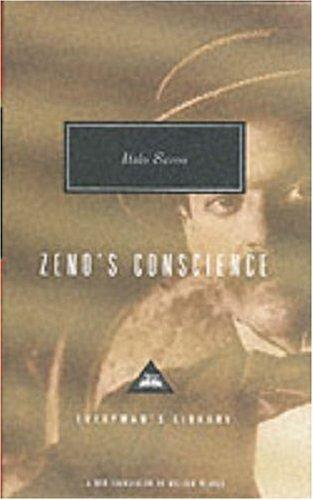
Zeno's Conscience
Italo Svevo · 1861–1928 · Italy
Originally La coscienza di Zeno (Italian)
Why it matters
Ordered by his psychoanalyst to write his life story, chronic failed quitter Zeno Cosini turns every relapse, marriage, and business blunder into an alibi. Svevo's late masterpiece is modernism's funniest unreliable confession: self-knowledge forever one excuse away.
At a glance
A digressive, achronological confession whose irony depends on distrusting the narrator at every turn.
Deep dive
Why a man ordered to write his own case history keeps producing better alibis than insight, and what that says about the whole idea of a therapeutic confession.
Written for readers who have finished the book. No plot recap, and nothing here is safe to read first.
Themes & symbolism
Zeno's memoir is structured as a cure and functions as its opposite: every chapter he offers his analyst as evidence of self-understanding — the endless "last cigarette," the father's ambiguous final slap he can't stop re-narrating in his own favor, the marriage to Augusta that begins as a consolation prize and becomes real love almost by accident — reads to us as exactly the evasion psychoanalysis is meant to dissolve. Svevo, writing out of Trieste's mixed, cosmopolitan culture with Freud's new vocabulary freshly in the air, builds the comedy out of a serious proposition: talking endlessly and fluently about yourself is not remotely the same operation as knowing yourself, and Zeno's fluency is precisely what lets him keep not knowing.
The business plot with Guido — Zeno's bumbling, unintentional profit from his brother-in-law's failures, capped by literally leading the funeral procession to the wrong cemetery — works as slapstick and as thesis at once: Zeno succeeds in life by accident at exactly the rate he fails to understand himself on purpose, and the novel's comic momentum depends on us liking him anyway, which is its own quiet argument that likability and self-knowledge have nothing to do with each other.
Svevo's achronological structure, organized by theme (the cigarette, the father, the marriage, Guido) rather than by chronology, mimics how an analysand actually free-associates in treatment, circling the same handful of wounds from different angles rather than marching through a life in order. That structure is itself the novel's sly argument against the case-history format Zeno has been ordered to produce: real memory doesn't organize itself into tidy chapters, and Zeno's inability to tell his story straight is presented as more honest, not less, than a properly linear confession would be.
The last seal: what actually happens, and why it lands the way it does.
The ending, explained
Furious at his analyst's verdict on him, Zeno quits treatment and declares himself cured — not of anything specific, just of therapy itself, which he decides was never going to fix a condition he now reframes as universal rather than personal. In the memoir's startling final turn, written in Zeno's own voice just after the First World War, he speculates that neurosis isn't his private affliction but mankind's baseline state, and that only a catastrophe vast enough — he imagines an apocalyptic explosion that purges the sick along with the healthy — could ever actually cure it. The joke curdles into something closer to prophecy, and the whole memoir's premise of self-improvement collapses into a dark, comic shrug: understanding was never the point, because there was never going to be a cure that wasn't also an ending. Svevo, who had spent decades as a largely unread businessman-novelist before this book found an unlikely champion in James Joyce, gets in one last irony beyond Zeno's control: the confession that ends by declaring universal sickness the only honest diagnosis is also the book that finally made its author's name.