
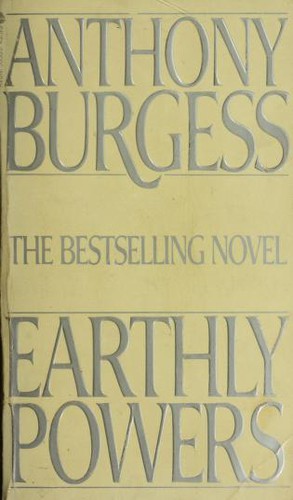
Earthly Powers
Anthony Burgess · 1917–1993 · England
Why it matters
A closeted, aging novelist recounts eighty years entangled with his brother-in-law, a pope on the road to sainthood, tracing the century's collisions of faith, fascism, and desire. Burgess's most ambitious, formally audacious novel.
At a glance
A dense, digressive, decades-spanning narrative packed with allusion.
Deep dive
A gay novelist recounts eighty years of the twentieth century's worst atrocities from his own front-row seat, all to answer one theological question his brother-in-law, the Pope, keeps asking him to help settle.
Written for readers who have finished the book. No plot recap, and nothing here is safe to read first.
Themes & symbolism
Burgess opens with one of English fiction's most quoted first lines, Kenneth Toomey recalling being in bed with his catamite on his eighty-first birthday when the Archbishop arrives, and the sentence does real structural work beyond shock value: it announces immediately that Toomey, a wildly successful, closeted-then-not popular novelist modeled loosely on Somerset Maugham, will narrate the entire twentieth century's catastrophes through the lens of his own compromised, self-aware, thoroughly worldly perspective, never pretending to a moral high ground the material might seem to require. Toomey's decades crisscross Malaya, Chicago, wartime Europe, and Hollywood, brushing against Nazism, fascism, and eventually a cult's mass suicide, and Burgess uses Toomey's celebrity and his outsider's sexuality together to keep him perpetually present at history's worst moments without ever being its author.
The novel's real theological argument runs through Don Carlo Campanati, Toomey's brother-in-law, who rises from parish priest to Pope and asks Toomey, near the end of his own life, to testify for Carlo's canonization by recalling a miracle Carlo apparently performed decades earlier, healing a dying child in Chicago. Toomey's private, devastating discovery is that the healed child grows up to become the manipulative architect of a mass-suicide cult modeled directly on Jim Jones's Jonestown, which forces the novel's central question into the open: if Carlo's miracle was real, did his sanctity also underwrite an evil that wouldn't otherwise have existed, and does a genuine act of grace stop counting as grace once its consequences are traced far enough forward.
Toomey as Maugham's Shadow
Burgess builds Toomey's career, and much of his personality, from Somerset Maugham's real life story: the enormous commercial success alongside critical condescension, the decades spent abroad partly to live more openly as a gay man than England allowed, and the late-life stockpile of secrets that a writer this famous could never fully hide. Toomey's homosexuality, treated across the novel's whole century-long span, from criminalization through the war years to a more permissive old age, lets Burgess track how radically the world's willingness to let Toomey simply exist changed within a single lifetime, without ever letting Toomey himself become merely a symbol of that change rather than a specific, vain, brilliant, self-serving man.
The last seal: what actually happens, and why it lands the way it does.
The ending, explained
The healed child, grown into the charismatic cult leader Godfrey Manning, orchestrates a mass poisoning of his own followers in a scene deliberately built to mirror the real Jonestown massacre, and among the dead is Toomey's own great-niece and her children, closing the loop between Carlo's decades-old miracle and a catastrophe carried out largely by people Toomey has personally known and loved. Asked afterward to give the Vatican his account of the original healing for Carlo's canonization file, Toomey declines to state plainly whether he believes it was a real miracle, a supernatural evil, or coincidence, and Burgess leaves the refusal exactly where the whole novel has been heading: earthly power, whether it belongs to popes, novelists, or charismatic prophets, produces consequences too tangled to sort cleanly into grace and its opposite, and Toomey's final honesty is admitting he can't do the sorting Carlo is asking of him.
Where to go next
 Anthony Burgess · 1962A Clockwork OrangeLvl 7Fast paced
 Muriel Spark · 1961The Prime of Miss Jean BrodieLvl 4Fast paced
 Kingsley Amis · 1986The Old DevilsLvl 4Medium pace
 George Orwell · 1949Nineteen Eighty-FourLvl 4Fast paced
 Aldous Huxley · 1932Brave New WorldLvl 4Medium pace
 J. G. Farrell · 1973The Siege of KrishnapurLvl 5Medium pace