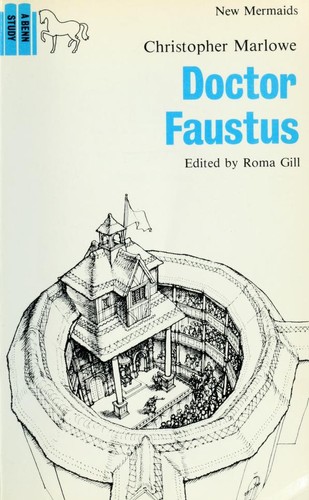
Doctor Faustus
Christopher Marlowe · 1564–1593 · England
Why it matters
A scholar sells his soul for twenty-four years of unlimited knowledge and power, then watches the clock run down onstage in real time. The Faust myth's first great dramatic form, and blank verse discovering it could carry damnation.
At a glance
Short and gripping; Elizabethan verse and comic subplot conventions are the only hurdles.
Deep dive
Why Faustus spends his unlimited power on party tricks instead of remaking the world, and what that choice says about what the play actually thinks of him.
Written for readers who have finished the book. No plot recap, and nothing here is safe to read first.
Themes & symbolism
Faustus opens the play imagining himself commanding armies, redrawing the map of the German states, damming the Rhine — the vocabulary of a man who assumes unlimited knowledge should produce unlimited consequence. What he actually does with twenty-four years and a devil at his service is startlingly small: invisible pranks on the Pope, an illusory grape harvest in winter, party tricks for an emperor, and, in the play's most famous scene, conjuring the shade of Helen of Troy purely for his own private gratification. The gap between the ambition and the use is the play's real satire — Marlowe isn't just staging a morality tale about forbidden knowledge, he's showing that a limited man handed unlimited power will still find a way to be small with it.
The Good Angel and Evil Angel who appear across the play aren't subtle, but they externalize a conflict that's really happening inside Faustus the whole time, and the Old Man who urges repentance near the end proves that redemption stays available almost to the last minute — Faustus's damnation is a failure to act on an open door, not a door that was ever shut. Marlowe's blank verse, still a relatively new tool for English drama, turns out able to carry both the grandeur of Faustus's opening ambitions and the terror of his final hour in the same instrument, which is part of why the play reads as a hinge point in what English dramatic verse could do. That tension between Renaissance ambition and inherited Christian morality is exactly why the play still reads as unresolved rather than settled on either side: it never straightforwardly celebrates Faustus's hunger for knowledge, but it doesn't let the framework condemning him go unquestioned either.
A clock the audience can hear
The final soliloquy is staged to run in something close to real performance time, with Faustus addressing the hour, then the half hour, then the final minutes directly, begging time to slow down or the stars to stop moving — a device almost unique in Elizabethan drama for making an audience feel a countable deadline rather than just describing dread. What makes the scene devastating rather than merely suspenseful is that Faustus's terror is entirely sincere and entirely useless: he wants to repent, says so, and still cannot complete the act, held back by a despair that his sin has already outrun God's mercy as much as by his continued grip on what Mephistopheles gave him. The scene indicts the theology of despair itself — the belief that one's sin is too large for forgiveness is, within the play's own logic, the final sin that seals the damnation.
The last seal: what actually happens, and why it lands the way it does.
The ending, explained
As the clock strikes the final hour, Faustus's pleading gives way to devils arriving to claim him, and scholars discover his body torn apart the next morning — a physical dismemberment that fits a life spent trading away his own coherent selfhood piece by piece for spectacle. He never manages to call on Christ or complete an act of repentance, even with the Old Man's urging and his own visible desire to be saved; the tragedy isn't that redemption was withheld but that he couldn't make himself take it. The Chorus's closing lines deliver a conventional moralizing warning against forbidden ambition, but the flatness of that epilogue after the preceding terror is itself part of the effect — no tidy moral fully accounts for what the audience just watched a man do to himself with the time he was given.