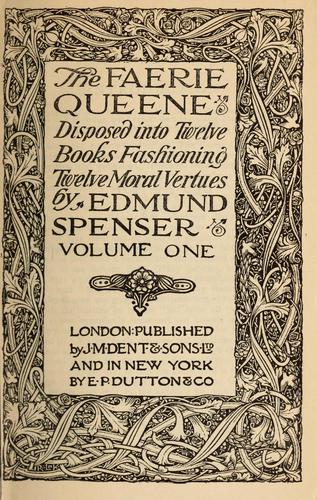
The Faerie Queene
Edmund Spenser · 1552–1599 · England
Why it matters
Knights embodying Holiness, Temperance, and Chastity quest through an allegorical dreamscape of dragons, enchantresses, and false doubles, all in praise of Elizabeth I. English poetry's most ambitious allegory, in a stanza invented for the purpose.
At a glance
Deliberately archaic language, layered allegory, and enormous length: the canon's steepest sustained climb.
Deep dive
Knights who are also virtues wander an allegorical dreamscape built to flatter a queen, in a project so vast its author never lived to give it an ending.
Written for readers who have finished the book. No plot recap, and nothing here is safe to read first.
Themes & symbolism
Every quest in the poem operates on at least two registers simultaneously, chivalric adventure and moral case study, so that Redcrosse Knight's struggle against the dragon threatening Una's parents' kingdom is also, without any tension between the two readings, the English Protestant church's struggle to secure Truth against the seductions of a Catholicism the poem personifies as Duessa, a sorceress whose disguises repeatedly fool Redcrosse into betraying the very truth he's sworn to defend. Spenser's allegorical types aren't flat stand-ins, though: Redcrosse's repeated falls into Duessa's deceptions, his despair, his near-collapse at the hands of the figure Despair itself, treat holiness as something achieved only through repeated, humiliating failure, not innate virtue, which is what keeps Book I readable as psychology and not just as doctrine dressed up in armor.
Britomart, introduced in Book III as the embodiment of Chastity, is the poem's most durable achievement precisely because Spenser refuses to make her virtue passive: she's a woman warrior who unhorses male knights in open combat, drives her own quest, searching for Artegall, the man she's destined to love, after glimpsing him in an enchanted mirror, and represents chastity not as simple virginal restraint but as faithful, chosen love, a redefinition that lets Spenser build an active female hero decades before the English novel would know what to do with one. Guyon's destruction of the Bower of Bliss in Book II works as the era's flip side of that same argument: the Bower's sensual perfection, its enchantress Acrasia, its unweaving of masculine will into passive pleasure, has to be physically leveled, not merely resisted, because Spenser's Temperance requires active mastery over pleasure rather than simply avoiding temptation's presence.
An Unfinished Monument
Spenser planned twelve books, one per Aristotelian virtue, arranged around knights who would eventually converge on Gloriana's court; he completed six plus fragments of a seventh, the 'Mutabilitie Cantos', before his death in 1599, leaving the poem's grand architecture permanently visible only as a blueprint. His dedicatory letter to Raleigh states the project's aim plainly, to fashion 'a gentleman or noble person in vertuous and gentle discipline', and Gloriana, the Faerie Queene herself, is true to that architecture: endlessly invoked as the poem's organizing destination and the figure for Elizabeth I, she never actually appears on the page, present only as the horizon every quest gestures toward. Spenser's stanza, nine lines of iambic pentameter closing on a longer alexandrine, ABABBCBCC, was invented specifically for this poem and has been called the Spenserian stanza ever since, and his diction, deliberately archaic even by 1590 standards, reaches back past his own contemporaries toward Chaucer, a choice that, along with his heavy debt to Ariosto's and Tasso's Italian romance epics, announces the poem's ambition to sit inside a continuous European epic tradition rather than merely modernize it.