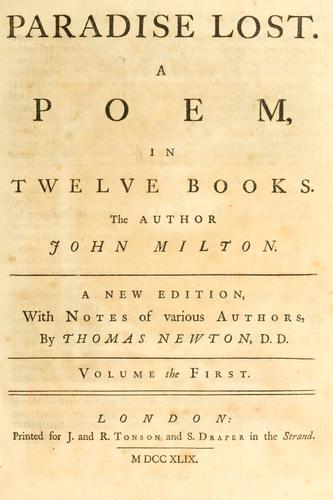
Paradise Lost
John Milton · 1608–1674 · England
Why it matters
Satan rebels, falls, and talks his way into Eden; Adam and Eve lose paradise knowingly. Genesis retold as cosmic epic by a blind revolutionary, with a devil so magnificent that readers have argued for centuries about whose side the poem is on.
At a glance
Latinate syntax suspended across dozens of lines, thick with classical and biblical allusion.
Deep dive
The poem's most notorious critical problem isn't in its plot but in its craftsmanship: why does the villain get the poetry.
Written for readers who have finished the book. No plot recap, and nothing here is safe to read first.
Themes & symbolism
Milton's Satan gets the epic's best rhetoric in its opening books — the defiant refusal to serve, the claim that the mind can make a heaven of hell — and that imbalance has driven readers since the Romantics to suspect the poem is secretly on his side. It isn't, quite; it's tracking his shrinkage. The rebel who addresses his legions as near-equals in Book 1 is, by Book 10, reduced to hissing among his followers as they're all transformed into serpents against their will, a mocking, involuntary punishment that replays and literalizes the temptation he inflicted on Eve. Satan's arc is a demonstration piece: rhetorical grandeur is not the same as moral stature, and the poem dares the reader to feel the pull of his eloquence precisely so that the fall into that feeling can be diagnosed rather than simply avoided.
The human fall runs on a different, harder engine: free will. Eve is deceived by flattery and the promise of godlike knowledge, but Adam is not deceived at all — he eats the fruit with his eyes open because he cannot bear to lose Eve to mortality alone, choosing love and companionship over obedience with full knowledge of the consequence. Milton insists on this distinction because the poem's theology depends on the Fall being chosen, not tricked into wholesale; a coerced fall would exonerate humanity and collapse the doctrine of free will the poem spends its middle books (Raphael's long warning visit, the War in Heaven) establishing. Milton's own biography sits underneath all of it: a revolutionary who had served a Puritan government that beheaded a king, writing an epic about rebellion against a divine monarch, blind and politically defeated by the time he dictated it.
Of the Devil's Party
William Blake's famous suggestion that Milton was unknowingly of Satan's party has shaped two centuries of reading, and it's worth taking seriously precisely because the poem gives it real ammunition: Satan is granted interiority, doubt, even something like grief, that God and the Son are not. The counter-argument, most forcefully made by C.S. Lewis, is that this is exactly the trap — that Satan's charisma is a special effect the poem builds and then dismantles, and that mistaking magnificent self-pity for heroism is the same error Eve makes at the tree.
The poem also stages a quieter, more human version of the same debate in Eden itself: Eve's suggestion that she and Adam work separately, which gives Satan his opening, has been read both as evidence of her independence being punished by the narrative and as evidence that Milton grants her real agency rather than treating her as simply an extension of Adam. The poem doesn't resolve this any more cleanly than it resolves Satan's status, and that refusal to settle is arguably the more Miltonic move than either side's certainty.
The last seal: what actually happens, and why it lands the way it does.
The ending, explained
After the Fall, the archangel Michael leads Adam to a hilltop and shows him a compressed vision of all future human history — murder, flood, oppression, and eventually Christ's incarnation and sacrifice, which will redeem what Adam has just destroyed. This is the doctrine of the fortunate fall: the Fall is a real catastrophe, but it opens the door to a redemption greater than unbroken innocence would ever have produced or required. Adam descends comforted rather than crushed. The poem's famous final image is not despair but motion — Adam and Eve leaving Eden hand in hand, the world now entirely before them, with Providence as their only guide, sorrow tempered by the sense that history, and choice, have only just begun.