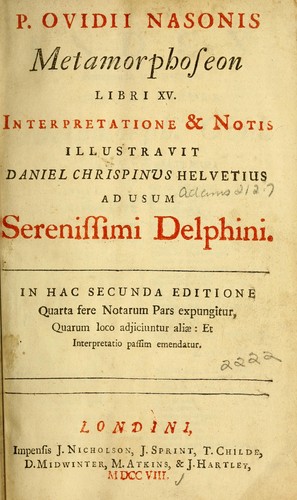
Metamorphoses
Ovid · 43 BCE–17 CE · Italy
Originally Metamorphoses (Latin)
Why it matters
Hundreds of myths (Daphne into laurel, Narcissus into flower, Arachne into spider) spliced into one continuous poem of transformation from creation to Ovid's own Rome. The single richest source of classical myth, mined by Chaucer, Shakespeare, and every painter since.
At a glance
Hundreds of interlinked myths and rapid transitions; best read episodically, not in one push.
Deep dive
A poem that claims change is the one constant in the universe ends by arguing its own verses are the one thing that won't change at all.
Written for readers who have finished the book. No plot recap, and nothing here is safe to read first.
Themes & symbolism
Ovid's organizing claim, laid out at the poem's opening and restated through Pythagoras's mouth in Book 15, is that nothing in the universe truly ends, it only changes shape, and the hundreds of stories in between are proof by accumulation. But transformation in Ovid is rarely gentle; it's what happens at the exact moment desire, violence, or hubris reaches its limit. Daphne becomes laurel to escape a god's pursuit, Actaeon becomes a stag and is killed by his own hounds for an accidental glance, Philomela and Procne become birds only after mutilation and a meal made of murdered flesh: transformation here is as often a punishment or an escape hatch from unbearable violence as it is a wonder, and Ovid's tonal trick is narrating both registers, the marvelous and the horrifying, in the same unbroken, faintly amused hexameter voice.
Art's power to transform and to endure is the poem's other great thread, running underneath the mythology itself. Arachne weaves a tapestry exposing the gods' own crimes, wins the contest on pure skill, and is punished into a spider anyway, an episode that reads as Ovid's sly acknowledgment that art can tell the truth about power and still be crushed by it. Pygmalion's statue becoming flesh runs the same idea in reverse, art's power made literally generative rather than punished. Both episodes prepare the poem's closing boast: having spent thousands of lines transforming gods, mortals, and monsters into trees, stones, and stars, Ovid transforms himself, claiming his poem will outlast bronze and pyramids and be read wherever Rome's power reaches, making his own textual survival the poem's final and most audacious metamorphosis.
One Continuous Poem, Not an Anthology
Ovid's real technical feat is making several hundred unrelated myths feel like a single unbroken narrative rather than a collection. Stories are chained by whoever happens to be listening to whom, by shared settings, or by a passing mention of one god that becomes the pretext for the next tale entirely, so the poem's forward motion never stops even as its cast changes completely from episode to episode. That structure is also why the book became the single most-raided source of classical myth for later art: because each story arrives self-contained and vividly staged, painters and poets could lift Daphne's transformation or Actaeon's death whole, without needing the surrounding epic machinery a Homeric or Virgilian episode would require, which is exactly how Titian, Bernini, Chaucer, and Shakespeare came to know these myths primarily through Ovid's versions rather than earlier Greek sources.
The last seal: what actually happens, and why it lands the way it does.
The ending, explained
The poem closes its long historical descent by arriving at Julius Caesar, whose soul, at his death, is shown ascending and transforming into a star, a scene that folds Rome's actual contemporary history into the same mythic logic that turned Daphne into a tree, presenting Caesar's deification as simply the latest entry in an unbroken chain of metamorphoses stretching back to creation. Ovid then steps forward in his own voice for the epilogue, boasting that his work will survive Jupiter's wrath, iron, and time itself, and that his name will be read and spoken wherever Roman power extends. It lands as both punchline and thesis: after a poem devoted to showing that nothing keeps its original form, the poet claims one exception for his own text, turning the entire work's closing gesture into an act of confident, faintly comic self-immortalization.