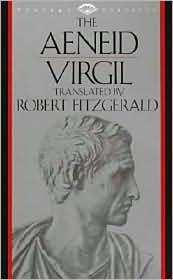
The Aeneid
Virgil · 70–19 BCE · Italy
Originally Aeneis (Latin) · translated by Robert Fagles
Why it matters
A Trojan survivor sails west through storm, love, and war to found the line that becomes Rome. Homer's epic machinery retooled into a national myth of duty, with an undertow of grief for everything empire costs, including its hero's happiness.
At a glance
Stately epic diction and a weight of Roman allusion, but a strong forward narrative line.
Deep dive
The empire this poem builds a myth for is founded on an act its own final line refuses to let the reader feel good about.
Written for readers who have finished the book. No plot recap, and nothing here is safe to read first.
Themes & symbolism
Virgil's governing word is pietas, dutiful submission to gods, family, and the destined nation, and the poem's structure is one long test of whether Aeneas can subordinate every private want to it. Dido is the test's hardest form: a woman worthy of him, ruling a city Rome will one day be at war with, and their affair is written with enough warmth that Aeneas's departure under divine order reads as a real loss, not a formality. Virgil doesn't let Aeneas simply be right to leave; Dido's curse over her pyre, calling down an avenger between their peoples, mythically accounts for Carthage's historical enmity with Rome, meaning the poem builds its own empire's future wars directly out of its hero's private betrayal.
Structurally the poem announces its ambitions by rewriting Homer from inside: the first half is an Odyssey of wandering, the second an Iliad of war for a bride and a kingdom, and both halves are bent toward a purpose neither Homeric poem had, justifying Rome and, through Anchises's underworld pageant of unborn Roman heroes ending in Augustus, justifying the current regime specifically. That national-myth machinery is what makes the poem's recurring undertow of grief so pointed: Aeneas is allowed almost no personal happiness, losing Creusa, Dido, and Pallas's protector Evander's peace of mind in turn, so that Rome's founding reads as something bought, continuously, at his expense.
Dido's Counter-Epic
Dido is given enough interiority and enough grievance that Carthage's queen threatens to unbalance the poem she's only meant to detour through. Her suicide is staged with deliberate irony: the pyre she has built under the pretense of burning relics that will release her from her love for Aeneas is stacked instead with the very sword and clothes he left behind, so that the instruments of his abandonment become the literal fuel for her death. Her final curse, summoning an unnamed avenger to rise from her bones against Aeneas's descendants, does double duty as personal vengeance and as the poem's own mythic explanation for the Punic Wars still centuries in Aeneas's future, binding Rome's greatest historical rival to a wound its founding hero inflicted on a woman who trusted him. Virgil compounds the discomfort in the underworld, where Aeneas encounters her shade again and tries to explain himself; she says nothing at all and walks away to rejoin her first husband, denying Aeneas even the closure of her anger, let alone her forgiveness.
The last seal: what actually happens, and why it lands the way it does.
The ending, explained
Aeneas has Turnus beaten and pleading in single combat and is visibly wavering toward mercy, the pietas he's shown throughout pulling him toward restraint, when he sees Pallas's sword belt worn on Turnus as a trophy. Rage, furor, the very quality the poem has spent twelve books training its hero away from, overtakes him instantly, and he kills Turnus on the spot. The poem's last line follows Turnus's resentful spirit down to the shades and simply stops there, with no coda, no return to Aeneas's state of mind, no reconciliation scene. That abruptness is deliberate: Virgil ends on the one moment that makes Rome's founding father look most like the enemies he's supposedly superior to, leaving unresolved whether Aeneas's act is justified vengeance for a fallen ally or the poem's quiet admission that empire is built by the same furor it claims to have civilized.