
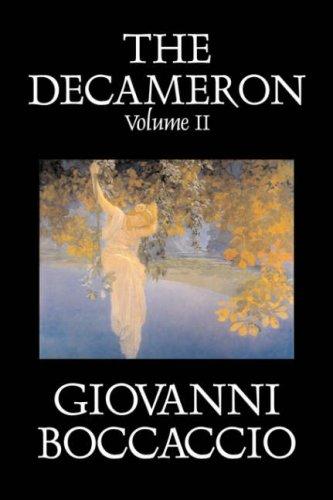
The Decameron
Giovanni Boccaccio · 1313–1375 · Italy
Originally Il Decameron (Italian)
Why it matters
Ten young Florentines flee the Black Death to a country villa and tell a hundred stories against it: of lust, trickery, luck, and cunning. Storytelling as survival, and the direct ancestor of Chaucer, the novella, and the modern short story.
At a glance
Long but modular: a hundred self-contained tales in plain, worldly prose.
Deep dive
Why ten young Florentines fleeing a plague spend ten days doing nothing but telling each other stories, and what that discipline is defending against.
Written for readers who have finished the book. No plot recap, and nothing here is safe to read first.
Themes & symbolism
The frame is the argument before a single tale gets told: Boccaccio's Introduction describes the Black Death tearing through Florence in 1348 with a clinical, horrified precision, bodies stacked in mass graves, family members abandoning each other, every social bond dissolving under the plague's pressure, and then removes seven women and three men from that city entirely, to a countryside villa where they impose strict order on their days: a leader chosen daily, a theme set for each round of stories, time set aside for music and rest. The stories that follow are not an escape from the plague so much as a structured, willed alternative to the disorder it produced.
Across the hundred tales, cleverness, ingegno, gets rewarded more consistently than virtue does. Merchants outwit each other, wives outwit suspicious husbands, and clergy are frequently exposed as frauds, most famously in the tale of Ser Cepparello, a monstrous sinner whose deathbed confession is so convincingly fabricated that he is venerated as a saint after his death. Boccaccio's Florence runs on wit and self-interest far more than on the pieties the church claimed governed it, and the collection rewards the brigata's own storytelling discipline, and the characters' cunning inside the stories, as parallel versions of the same value: intelligence as the thing that gets you through.
Order Imposed Against a City in Free Fall
The contrast Boccaccio builds between his Introduction's plague-stricken Florence and the villa's daily rituals, meals at set hours, a queen or king elected each morning, storytelling capped at ten tales a day, is deliberate structural argument rather than incidental scene-setting. Where the plague dissolved every social bond the Introduction lists, the brigata rebuilds a miniature, functioning society almost immediately, governed by consent and courtesy rather than fear. The hundred stories that follow are the proof of concept: civilization, Boccaccio suggests, survives less through institutions than through people choosing, together, to keep behaving like it still applies.
Griselda's Tale, Told Last and On Purpose
The collection's final story, told by Dioneo, concerns Griselda, a peasant wife whose husband tests her obedience through invented cruelties, including pretending to have their children killed, that she endures without complaint. Petrarch admired the tale enough to translate it into Latin, reading it as an allegory of the soul's endurance under God's testing, while Boccaccio's own narrator lets other pilgrims openly question whether the husband's tests were closer to madness than to virtue. Placing the most disturbing tale last, after ninety-nine stories about outwitting cruelty rather than enduring it, reads like Boccaccio ending the book on a genuine, unresolved argument rather than a moral.
Where to go next
 Geoffrey Chaucer · 1400The Canterbury TalesLvl 7Medium pace
 Dante Alighieri · 1320The Divine ComedyLvl 8Slow burn
 William Shakespeare · 1601HamletLvl 6Medium pace
 Ovid · 8 CEMetamorphosesLvl 6Fast paced
 Michel de Montaigne · 1580The EssaysLvl 6Slow burn
 Christopher Marlowe · 1592Doctor FaustusLvl 5Medium pace