
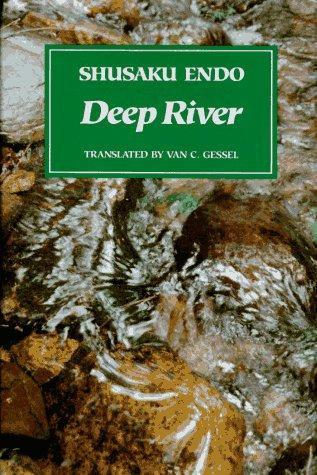
Deep River
Endō Shūsaku · 1923–1996 · Japan
Originally Fukai Kawa (Japanese) · translated by Van C. Gessel
Why it matters
Japanese tourists converge on the Ganges at Varanasi, each carrying private grief, and find a defrocked priest serving the dying regardless of creed. Endō's last novel widens Silence's question of faith to every religion at once.
At a glance
Multiple converging pilgrims' backstories build slowly toward a single shared destination and theme.
Deep dive
Four Japanese tourists carry very different unfinished business to the Ganges, and Endo is far more interested in what each of them is looking for than in whether they find it.
Written for readers who have finished the book. No plot recap, and nothing here is safe to read first.
Themes & symbolism
Otsu, a seminarian too odd and too sincere for the institutional Catholicism of his French seminary, develops a private theology that his professors treat as heresy: a God he can't stop calling an onion, present in Buddha, in Hinduism, in whatever name a given culture happens to use, rather than confined to one church's doctrine. Endo has him live that theology out literally in Varanasi, where Otsu spends his days carrying the region's destitute dying to the Ganges so they can end their lives beside the river they believe will save them, an act of service the institutional church he trained in would find at best eccentric and at worst blasphemous.
The tour group around him each carry a private wound to India rather than any interest in a temple itinerary. Isobe, widowed, chases fragile evidence that a child somewhere might be his wife reincarnated, holding to her dying claim that she would be reborn even though nothing in his own rationalism supports it. Kiguchi carries decades of unspoken guilt from the starvation retreat through Burma, where his unit resorted to acts he has never told anyone about. Mitsuko, who once seduced Otsu in college purely to test whether she could break his faith, arrives cynical and finds, against her own expectations, that reconnecting with him unsettles the emptiness she's carried through a marriage and a divorce since. Endo lets the Ganges hold all of these griefs at once without ranking whose is more legitimate or more Christian.
Christ as an Onion
Otsu's private name for God, an onion with layer after layer and no fixed center, is his way of keeping faith without keeping the exclusivity his seminary insists on. It's also Endo's clearest statement of his own long argument with Japanese Catholicism, a European import that had never comfortably answered how a specifically Japanese sense of the sacred, syncretic and unbothered by doctrinal borders, should relate to a single true church. Otsu's superiors read his onion as evasion. The novel reads it as the only theology flexible enough to survive actual contact with human suffering on the scale Varanasi offers.
Kiguchi's Burma
Endo grounds Kiguchi's guilt in the real catastrophe of Japan's 1944 retreat from Burma, when entire units starved on jungle roads and some survivors, by multiple postwar accounts, resorted to eating the dead. Endo doesn't dramatize the act itself so much as its afterlife, the specific, decades-long silence a man carries when the worst thing he ever did was also the thing that kept him alive. Kiguchi's trip to India, ostensibly to hold a memorial for a wartime comrade, is really an attempt to find some frame large enough to hold an act his own country has never made room to discuss.
The last seal: what actually happens, and why it lands the way it does.
The ending, explained
The tour group's visit to the ghats coincides with rising communal tension in the city, and when a member of the party provokes a crowd already primed for violence, Otsu wades in to pull him free and is set upon by the mob himself. Endo declines to confirm whether he survives, letting the ambiguity stand as its own statement: a man who spent the novel insisting that Christ's real work is to keep dying quietly beside people no official church will claim doesn't get a clean martyrdom scene, just an unresolved absence. Isobe never gets proof his wife has been reborn, Kiguchi never gets absolution, and Mitsuko is left standing at the river with exactly the kind of unresolved feeling Otsu always told her was the beginning of faith rather than its failure.
Where to go next
 Endō Shūsaku · 1966SilenceLvl 5Slow burn
 Yukio Mishima · 1956The Temple of the Golden PavilionLvl 6Slow burn
 Kenzaburō Ōe · 1964A Personal MatterLvl 5Medium pace
 Kōbō Abe · 1962The Woman in the DunesLvl 5Medium pace
 Osamu Dazai · 1948No Longer HumanLvl 4Medium pace
 Graham Greene · 1940The Power and the GloryLvl 5Medium pace