
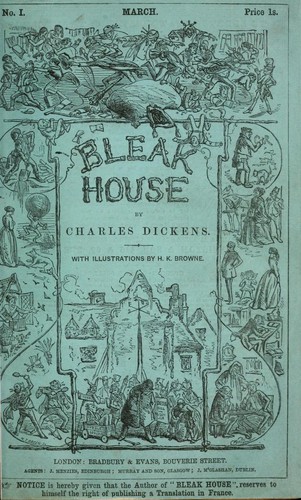
Bleak House
Charles Dickens · 1812–1870 · England
Why it matters
A lawsuit that devours generations, fog as the first character, and a double narration decades ahead of its time. The summit of Dickens's social vision: the novel as indictment of an entire system.
At a glance
Dual narrators, a sprawling cast, and a labyrinthine legal plot spanning decades.
Deep dive
What the fog choking London in the opening pages is standing in for, and how two clashing narrators add up to a single verdict on the law.
Written for readers who have finished the book. No plot recap, and nothing here is safe to read first.
Themes & symbolism
The novel opens with fog everywhere — up the river, down the river, in the eyes and throats of Chancery lawyers — before the narration ever names a character, because the fog is the argument: an entire legal system so self-perpetuating that it has become a kind of weather, ambient and inescapable. The Jarndyce and Jarndyce suit, by the time the novel starts, has already outlived the understanding of everyone still nominally suing over it; Dickens's satire lands hardest on "telescopic philanthropy," Mrs. Jellyby's obsessive charity work for a African mission while her own children go hungry and unwashed in the next room — a system that has trained even good intentions to look everywhere except at the poverty on its own doorstep, embodied by Jo, the homeless crossing-sweep the plot keeps almost, then fatally, failing.
Esther Summerson's shame at her own illegitimate birth, drilled into her from childhood by her guardian aunt, becomes a private version of the public rot: a stain assigned to her by a moral bookkeeping as arbitrary and merciless as Chancery's. Her mother, Lady Dedlock, spends the novel performing an icy social perfection that is really the most exhausting kind of secrecy, and the discovery of her past by the lawyer Tulkinghorn turns her glamor into a liability that can be blackmailed. Krook, the rag-and-bottle dealer who hoards paper he can't read and calls himself, in mockery, the "Lord Chancellor," combusts spontaneously in his own shop — Dickens insisted in his preface the death was scientifically documented, but inside the novel it plays as a system consuming itself from the inside, exactly as Chancery eventually does.
Two Narrators, One Indictment
Dickens splits the book between Esther's modest, retrospective first person and an anonymous, present-tense narrator who sees everything and forgives no one — a formal experiment years ahead of its moment. Esther's chapters supply the moral warmth and coincidence-driven plotting of Victorian romance; the anonymous chapters supply the corrosive social panorama, moving in a single breath from a fashionable drawing room to a graveyard slum. Neither voice alone could hold the novel's argument that private virtue and public catastrophe are the same story told at different scales.
Chancery as the Real Villain
No single lawyer or litigant is the novel's antagonist; the suit itself is, an institution with no author and no exit, generating fees regardless of outcome. Richard Carstone's slow disintegration — chasing the case's resolution as if hope itself were a career — makes the abstraction lethal, and Dickens times the revelation of where the entire disputed fortune actually went to land exactly when it can no longer save him.
The last seal: what actually happens, and why it lands the way it does.
The ending, explained
The Jarndyce and Jarndyce suit finally resolves — not with a verdict for anyone, but with the discovery that the entire disputed estate has been consumed by decades of legal costs, leaving nothing for any claimant. Richard, whose health and sanity had been mortgaged entirely to the hope of winning, collapses and dies on learning it, the case's real casualty. Lady Dedlock, fleeing exposure of her past, is found dead at the gate of the pauper burial ground where her former lover, Nemo, lies buried — position mirroring position, the aristocrat and the outcast finally equal in death. Esther, freed of the secret that shaped her, marries Allan Woodcourt, the one relationship in the book untouched by Chancery's rot.
Where to go next
 Charles Dickens · 1838Oliver TwistLvl 4Fast paced
 Charles Dickens · 1839Nicholas NicklebyLvl 4Fast paced
 Charles Dickens · 1843A Christmas CarolLvl 2Fast paced
 Charles Dickens · 1850David CopperfieldLvl 5Medium pace
 Charles Dickens · 1854Hard TimesLvl 4Medium pace
 Charles Dickens · 1857Little DorritLvl 7Slow burn