
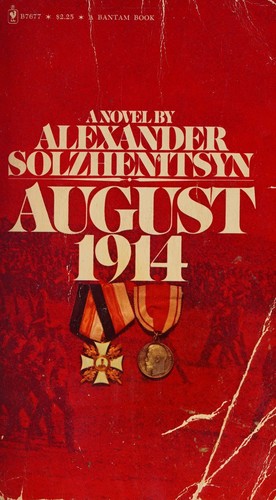
August 1914
Aleksandr Solzhenitsyn · 1918–2008 · Russia
Originally Avgust Chetyrnadtsatogo (Russian) · translated by H.T. Willetts
Why it matters
The Russian army's catastrophic defeat at Tannenberg opens Solzhenitsyn's vast historical cycle on the empire's slide toward revolution. The first knot of The Red Wheel applies Tolstoyan panorama to a war Tolstoy never lived to see, tracing 1917's roots to 1914's first battlefield.
At a glance
A huge cast and interleaved historical-essay chapters trace one battle's causes at Tolstoyan scale.
Deep dive
Solzhenitsyn opens his vast historical cycle on Russia's road to revolution with a battlefield disaster three years before anyone in it knows a revolution is coming, and lets one doomed army's confusion stand in for the whole empire's.
Written for readers who have finished the book. No plot recap, and nothing here is safe to read first.
Themes & symbolism
The Battle of Tannenberg, where General Samsonov's Russian Second Army is encircled and destroyed by German forces in the war's opening weeks, gives Solzhenitsyn his first knot, the term he used for each installment of a projected Red Wheel cycle meant to cover the whole slide from 1914 to 1917, though only a handful of the planned knots were ever finished. Solzhenitsyn intercuts fictional characters, most centrally the staff officer Colonel Vorotyntsev, with real historical figures rendered under their own names, so Samsonov's actual documented indecision and eventual suicide after the defeat sit inside the same narrative as invented soldiers and officers, history and fiction given equal narrative weight rather than one serving as backdrop for the other.
Solzhenitsyn interleaves the battle chapters with essayistic digressions on Russian military bureaucracy, incompetent high command, and the empire's structural rot, a technique borrowed openly from Tolstoy's War and Peace but turned toward the opposite conclusion: where Tolstoy's Russia ultimately validates itself through 1812's victory, Solzhenitsyn's 1914 offers no such vindication, only a professional army squandered by leadership that never has to answer for its failures, three years before the same empire collapses for reasons this defeat already forecasts in miniature. Vorotyntsev's clear-eyed assessments of the command failures around him, delivered to superiors who have no interest in hearing them, give the novel its closest thing to a Tolstoyan moral center, a soldier whose competence the system has no real use for.
The novel's title names a single month, but Solzhenitsyn's real subject is the habit of institutional denial that will carry Russia, largely unchanged, from this defeat all the way to 1917: officers protect their own reputations rather than their men, dispatches get rewritten to soften bad news before they reach the Tsar, and nobody with the authority to fix the underlying rot has any incentive to admit it exists. Reading Tannenberg through that lens turns a single lost battle into a preview of the empire's entire terminal condition.
A Cycle Solzhenitsyn Never Finished
August 1914 was meant to be the opening knot of The Red Wheel, a project Solzhenitsyn originally sketched out to run in dense, essay-interleaved installments all the way through the civil war of 1922. He worked on it across decades of exile and eventual return to Russia, but only completed four knots covering 1914 through early 1917, leaving the revolution's actual climax, the event the entire cycle was built to explain, permanently outside the finished text.
The last seal: what actually happens, and why it lands the way it does.
The ending, explained
Samsonov, having lost contact with his own scattered corps and unable to accept the scale of the disaster he's presided over, rides off from his surviving staff and shoots himself in the forest rather than report the defeat, a death Solzhenitsyn renders from the documented historical record rather than as an invented flourish. Vorotyntsev survives the encirclement and makes his way back through German lines to deliver a furious, detailed account of the command failures that caused it, only to watch the report absorbed and neutralized by an army bureaucracy with no mechanism for acting on inconvenient truths. Solzhenitsyn's real ending isn't the battle but that absorption: a warning correctly diagnosed and then filed away, the same institutional deafness that will make 1917 possible already fully operational in 1914.
Where to go next
 Aleksandr Solzhenitsyn · 1962One Day in the Life of Ivan DenisovichLvl 3Fast paced
 Aleksandr Solzhenitsyn · 1966Cancer WardLvl 5Medium pace
 Aleksandr Solzhenitsyn · 1968The First CircleLvl 6Medium pace
 Aleksandr Solzhenitsyn · 1973The Gulag ArchipelagoLvl 6Slow burn
 Mikhail Sholokhov · 1928And Quiet Flows the DonLvl 5Medium pace
 Vasily Grossman · 1980Life and FateLvl 7Medium pace