
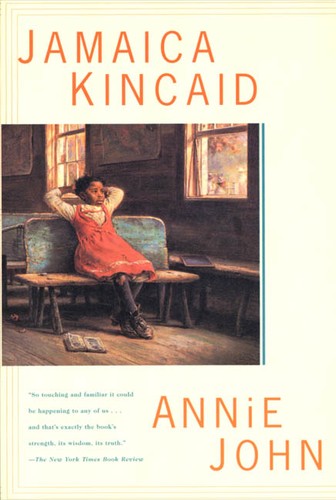
Annie John
Jamaica Kincaid · b. 1949 · Antigua
Why it matters
A girl's fierce devotion to her mother curdles into fury and estrangement against the small colonial tyrannies of 1950s Antigua. Coming-of-age rendered with an unsparing, incantatory intensity rare in the bildungsroman.
At a glance
Plain, direct sentences carry real emotional and psychological complexity beneath simple surfaces.
Deep dive
How a mother-daughter idyll turns to open warfare, and why leaving home reads as both liberation and an unhealed wound.
Written for readers who have finished the book. No plot recap, and nothing here is safe to read first.
Themes & symbolism
The novel's real subject is the violence latent in a maternal love so total it leaves no room for a separate self. Annie's mother, who once dressed her, bathed her, and shared cloth cut for matching outfits, becomes intolerable to Annie exactly because that intimacy curdles into control the moment Annie starts becoming her own person — and Annie experiences her mother's sudden pivot toward grooming her for a respectable, conventional womanhood as rank hypocrisy, since the freedoms her mother once had are now denied her. That domestic rupture doubles the island's colonial politics: British schooling in Antigua, with its lessons in English history and manners as the measure of civilization, offers approval on the same terms as the mother does — obedience to an imposed standard that has no room for the student's actual self, which is exactly what gets Annie punished when an essay reveals real feeling instead of the sanctioned version of it.
Annie's intense friendships — with Gwen, and later with the gloriously unwashed, rule-breaking 'Red Girl' — mark stations of resistance before the final rupture with her mother, and her mysterious, undiagnosed fever late in the novel is the body registering what the plot won't state outright: a psychosomatic collapse tellingly treated by an obeah woman rather than Western medicine, a small assertion of a submerged Caribbean world underneath the colonial one Annie is otherwise being drilled into.
Kincaid, Antigua, and the Autobiographical Rupture
Kincaid (born Elaine Potter Richardson) drew the novel directly from her own Antiguan adolescence and her own furious break with her mother, whom she has described elsewhere, including in the nonfiction A Small Place, as loving in ways that were also suffocating and punitive. Kincaid herself left the island at seventeen, ostensibly to work as an au pair, in a departure she has characterized as both a genuine escape and a wound distance never closed — she stayed away for nearly two decades, and her real relationship with her mother remained fraught for the rest of her mother's life. That same doubled charge, freedom and damage in the same gesture, is what keeps the novel's ending from resolving into simple triumph. Kincaid's prose — incantatory, built on repetition and cataloguing, a mode she'd sharpen further into A Small Place's furious address to tourists — turns ordinary domestic betrayals into something with the pressure of ritual.
The last seal: what actually happens, and why it lands the way it does.
The ending, explained
Once her unexplained fever passes — Kincaid leaves its cause a verdict on Annie's psychological state rather than a medical diagnosis — seventeen-year-old Annie prepares to leave Antigua for England to train as a nurse. The farewell at the dock is stiff and oddly formal, years of accumulated rupture compressed into a goodbye neither woman quite knows how to perform sincerely anymore. Annie sails away watching the island recede, and the prose refuses to say whether this is a happy ending: leaving is real freedom from a suffocating mother and a suffocating island, but it's also an admission that the wound between them isn't something adulthood or an ocean can simply cure — it's the price of becoming a separate person at all.
Where to go next
 Tsitsi Dangarembga · 1988Nervous ConditionsLvl 4Medium pace
 V. S. Naipaul · 1961A House for Mr BiswasLvl 5Medium pace
 Banu Mushtaq · 2025Heart Lamp: Selected StoriesLvl 4Fast paced
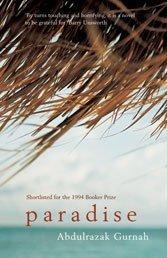 Abdulrazak Gurnah · 1994ParadiseLvl 5Medium pace
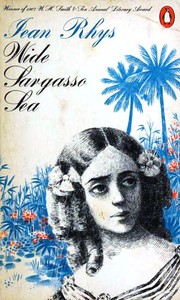 Jean Rhys · 1966Wide Sargasso SeaLvl 6Slow burn
 Anita Brookner · 1984Hotel du LacLvl 5Slow burn