
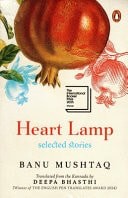
Heart Lamp: Selected Stories
Banu Mushtaq · b. 1948 · India (Karnataka)
Originally Heart Lamp: Selected Stories (Kannada) · translated by Deepa Bhasthi
Why it matters
Selected stories spanning five decades track Muslim women's lives in southern India: domestic confinement, religious authority, and small, wry acts of defiance. The first short-story collection and first Kannada-language work to win the International Booker Prize.
At a glance
Individually accessible stories in plain, direct prose, though the collection rewards reading them together.
Deep dive
Selected stories spanning three decades, and the domestic language of triple talaq, mosque politics, and a mother-in-law's tyranny that only worked once an English translator refused to iron it flat.
Written for readers who have finished the book. No plot recap, and nothing here is safe to read first.
Themes & symbolism
Banu Mushtaq, a lawyer and activist as well as a writer, sets her stories inside Muslim households across small-town and rural Karnataka, where the mechanisms of control are almost entirely domestic: husbands who take a second wife or invoke talaq on a whim, clerics who rule on a woman's grief or desire from outside her marriage entirely, mothers-in-law who enforce the same subjugation they once endured. The title story, in which a wife pushed toward despair by her husband's open affair is talked back from the edge not by any institution but by her own children, states the collection's method directly: the state, the mosque, and the courtroom rarely intervene in these stories, so what survival exists has to come from inside the family itself, often from the very women and children with the least formal power in it.
Mushtaq wrote these stories across more than three decades, from the 1990s into the 2020s, out of the Bandaya Sahitya movement, Kannada protest literature that took caste, gender, and religious orthodoxy as its direct subject rather than backdrop, and the collection's range lets a reader track how consistent the pressures on these women stay even as the decades pass. Comedy keeps surfacing inside the grimmest situations, a wry, exhausted humor rather than relief, which is closer to how the women in these households actually seem to survive their circumstances than any purely tragic register would be.
Translating Without Flattening
Deepa Bhasthi's translation, which won the International Booker Prize in 2025 alongside Mushtaq, the first Kannada work and the first short story collection to win, keeps a working vocabulary of Kannada, Urdu, and Arabic words untranslated and unitalicized on the page rather than smoothing them into English equivalents or a glossary, a choice Bhasthi has described as refusing to let English readers forget whose language this originally is.
A Lawyer's Casework Behind the Fiction
Mushtaq's decades representing women in family and community disputes show up directly in how precisely these stories render legal and religious mechanisms, a husband's casual pronouncement of divorce, a cleric's authority over a widow's remarriage, rendered with the specificity of someone who has watched those mechanisms actually operate on real women rather than imagined how they might.
Where to go next
 U. R. Ananthamurthy · 1965SamskaraLvl 6Slow burn
 Jamaica Kincaid · 1985Annie JohnLvl 4Medium pace
 J. M. G. Le Clézio · 1980DesertLvl 5Slow burn
 Mulk Raj Anand · 1935UntouchableLvl 3Fast paced
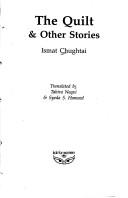 Ismat Chughtai · 1942The Quilt and Other StoriesLvl 4Fast paced