
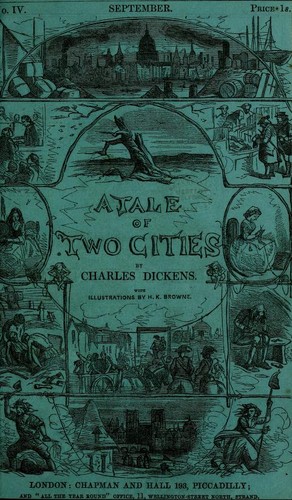
A Tale of Two Cities
Charles Dickens · 1812–1870 · England
Why it matters
Paris and London entwine across the French Revolution's Terror, a dissolute lawyer and his aristocratic double drawn together toward the guillotine's shadow. Dickens's only true historical novel trades his usual social panorama for a compressed, propulsive plot of doubles and redemption.
At a glance
Tighter and faster than typical Dickens, though the doubling plot and revolutionary backdrop need tracking.
Deep dive
Why a dissolute lawyer who has wasted his entire life becomes the one character capable of giving the novel's central act of substitution its full weight.
Written for readers who have finished the book. No plot recap, and nothing here is safe to read first.
Themes & symbolism
Dickens opens Dr. Manette's story as a literal resurrection: eighteen years in the Bastille reduced him to a shoemaker mumbling a cell number, and Lucie's patient nursing back to coherence is announced, repeatedly, as the recall to life the title borrows its central phrase from. That resurrection language then extends past Manette to structure the whole novel, since every major reversal, Darnay's escape from an English treason charge, Carton's walk to the scaffold, restages the same idea in a new key: a person given back a life that was, by any ordinary reckoning, already finished.
Sydney Carton and Charles Darnay share a face so exactly that it once got Darnay acquitted in an English courtroom, and Dickens spends the whole novel setting up what that resemblance is actually for: not a plot convenience but a mechanism of substitution, since Carton can walk into Darnay's cell, drug him, and take his place at the guillotine only because two men who share nothing but a face can, in a pinch, share a fate. Carton's early, half-drunk confession to Lucie that he would do anything for her and anyone she loves reads as a throwaway sentiment on first pass and becomes the whole plot's blueprint on a second one.
Madame Defarge's knitting, which looks throughout the book like an ordinary domestic habit, is revealed to be a coded register of the aristocrats condemned to die once the Terror arrives, and Dickens is careful to root her fury in a specific, personal history rather than abstract revolutionary principle: the Evrémonde brothers raped her sister and killed her brother years before the novel begins. The knitting isn't collective memory in any impersonal sense, it's one woman's private ledger of grievance dressed in the language of justice for an entire class, and Dickens uses her to warn that revolutionary terror answering aristocratic cruelty in kind produces the same cruelty wearing a different uniform.
A Wasted Life Made to Matter Retroactively
Carton spends the novel as literature's model of squandered talent, a brilliant lawyer's mind wasted on drink and self-contempt while he watches Darnay win, effortlessly, the life and the woman Carton believes he could never deserve. Dickens's real interest isn't redemption in any religious sense so much as retroactive meaning: the act of substitution doesn't erase the wasted years, it simply gives them, at the very end, a shape and a purpose they never had while Carton was still living them forward rather than toward a fixed point.
The last seal: what actually happens, and why it lands the way it does.
The ending, explained
Darnay is condemned largely on the strength of a letter Dr. Manette himself wrote in the Bastille years earlier, a document he had entirely forgotten, denouncing the Evrémonde family for the very crimes against Madame Defarge's family that now doom his own son-in-law by inherited name. Carton bribes his way into the prison, drugs Darnay, and has him carried out disguised as himself, sending Darnay and Lucie's family safely toward England while he waits, alone, to be tried and guillotined in Darnay's place. In his final imagined vision, narrated in the second person as a future he will never see, Carton foresees a peaceful, resolved life for the family he has saved and, closing on the famous line about a far, far better rest than he has ever known, dies having converted a lifetime of wasted potential into the single decisive act the rest of the book had been quietly building toward.
Where to go next
 Charles Dickens · 1838Oliver TwistLvl 4Fast paced
 Charles Dickens · 1839Nicholas NicklebyLvl 4Fast paced
 Charles Dickens · 1843A Christmas CarolLvl 2Fast paced
 Charles Dickens · 1850David CopperfieldLvl 5Medium pace
 Charles Dickens · 1853Bleak HouseLvl 7Slow burn
 Charles Dickens · 1854Hard TimesLvl 4Medium pace