
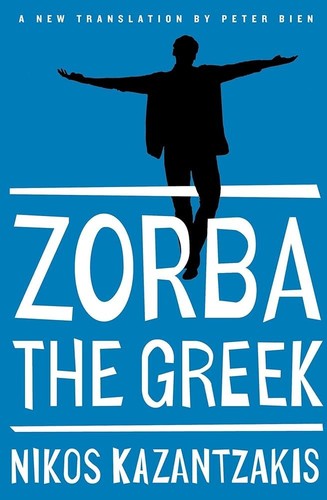
Zorba the Greek
Nikos Kazantzakis · 1883–1957 · Greece
Originally Vios kai Politeia tou Alexi Zorba (Greek)
Why it matters
A bookish narrator's mining venture in Crete becomes a duel with his foreman Zorba, whose bottomless appetite for food, women, and dance argues for living without fear or restraint. Kazantzakis's most beloved book stages flesh against spirit and never quite declares a winner.
At a glance
Plainspoken adventure narrative carrying heavy philosophical freight beneath it.
Deep dive
A bookish narrator hires a foreman whose bottomless appetite for food, women, and dance seems to answer everything his books can't — but Kazantzakis won't let that philosophy off easy either.
Written for readers who have finished the book. No plot recap, and nothing here is safe to read first.
Themes & symbolism
The narrator, drafting a book about the Buddha throughout — itself a symbol of renunciation and detachment from the physical world — is the novel's stand-in for a whole tradition of bloodless intellectualism, and Zorba's total, unphilosophical embrace of food, wine, women, and his santuri is staged as the corrective the narrator both envies and can't fully inhabit himself. Their long arguments never resolve into a winner; Kazantzakis stages flesh against spirit as a genuine dialectic, with Zorba's vitalism supplying real wisdom the narrator's books had missed, but never quite earning the last word either.
The village widow's story supplies the novel's darkest counter-note to Zorba's philosophy of joyful excess: Pavlos's obsessive unrequited love for her ends in his own death, his loss is blamed on her, and the village men murder her in a mob killing framed as honor — which the narrator watches happen and fails to stop despite all his professed sympathy. Vitalism and community, the novel insists, are capable of real collective cruelty as well as liberation; Zorba's philosophy of living without fear is not offered as a naive cure-all so much as one honest answer among several to a world that also produces this.
The Mine as Metaphor
The Cretan lignite venture, financed on the narrator's dwindling inheritance and Zorba's increasingly wild engineering schemes — most spectacularly an aerial cable system for hauling timber down the mountainside — is less a business plot than a controlled experiment: what happens to two very different men's philosophies when actual money, actual labor, and actual risk are put behind them. Its outcome matters to the novel not as tragedy but as the necessary condition for its philosophical payoff, stripping away the last thing — solvency — that might have let the narrator keep living in his head instead of his body.
Kazantzakis's Own Divided Self
Kazantzakis, a serious student of Buddhism, Nietzsche, and Bergson who nonetheless spent his life chasing physical adventure and political engagement, wrote Zorba as something close to wish fulfillment — the narrator's paralyzed intellectualism is recognizably the author's own besetting temptation, and Zorba the vitalist he wished he could simply become. He later asked to be buried without religious or state honors, his chosen epitaph declaring he hoped for nothing, feared nothing, and was free — a line that reads like something Zorba might have said, if Zorba had ever bothered to write it down.
The last seal: what actually happens, and why it lands the way it does.
The ending, explained
The cable system collapses spectacularly on its first real test, destroying the entire mining investment within minutes and wiping out the narrator's inheritance along with it. Standing in the wreckage of a venture that should represent total ruin, Zorba bursts into laughter, then pulls the narrator into a dance on the beach — teaching him, at the exact moment worldly failure should call for despair, the one lesson none of the narrator's books could give him: how to meet catastrophe with unguarded joy rather than analysis. Kazantzakis ends the novel on that dance rather than on any resolution of the flesh-versus-spirit argument, because the dance is the argument's actual resolution — not a philosophical conclusion but a physical one.
Where to go next
 Nikos Kazantzakis · 1953Freedom or DeathLvl 6Fast paced
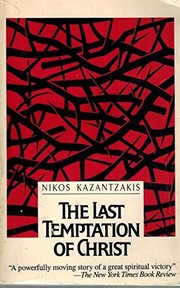 Nikos Kazantzakis · 1955The Last Temptation of ChristLvl 6Medium pace
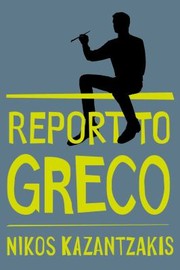 Nikos Kazantzakis · 1961Report to GrecoLvl 6Slow burn
 Miguel de Unamuno · 1914MistLvl 6Medium pace
 Jean-Paul Sartre · 1938NauseaLvl 6Slow burn
 André Gide · 1902The ImmoralistLvl 5Medium pace