
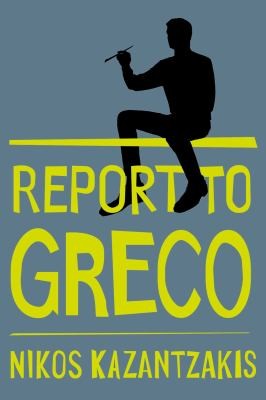
Report to Greco
Nikos Kazantzakis · 1883–1957 · Greece
Originally Anafora ston Greko (Greek)
Why it matters
Kazantzakis's posthumous spiritual autobiography, addressed to his Cretan ancestor El Greco, recasts his own restless pilgrimage through Christ, Buddha, Lenin, and Nietzsche as one long wrestling match with God. His summing-up, written as he was dying.
At a glance
Digressive, essayistic chapters trace a lifetime of philosophical wandering rather than a linear plot.
Deep dive
Why Kazantzakis addressed his own life's summing-up to a dead Cretan painter, and what that framing lets him get away with as an autobiography.
Written for readers who have finished the book. No plot recap, and nothing here is safe to read first.
Themes & symbolism
Kazantzakis writes Report to Greco as a direct address to El Greco, the Cretan-born painter dead three and a half centuries before him, and the device is not decorative: by reporting to an ancestor rather than to the reader, he frees himself to narrate his own life as a spiritual campaign rather than a chronicle, selecting and mythologizing episodes, his grandfather forcing him as a boy to watch a public hanging, his walking pilgrimage up Mount Athos, in a way a memoir organized around chronology alone never would.
The book's real structure is a sequence of wrestling matches with figures Kazantzakis treats as stages of the same struggle: Christ, Buddha, Lenin, and Nietzsche each get a section as a rival claimant on his soul, not case studies but opponents he genuinely tries to defeat and be defeated by in turn. His famous formula, carved eventually onto his own gravestone, 'I hope for nothing, I fear nothing, I am free,' is less a conclusion the book reaches than a position it keeps testing against each new figure who might disprove it.
Zorba's Real-Life Model, One Chapter Among Many
The illiterate, life-devouring laborer George Zorbas, whom Kazantzakis later turned into the novel Zorba the Greek, appears here as one episode in a longer procession of teachers, not the culminating figure the novel made him. Report to Greco insists on a proportion the novel didn't need to keep, placing Zorba's appetite for direct experience beside Kazantzakis's grandfather, his teacher on Mount Athos, and Lenin's Moscow with equal weight, which is the surest evidence that Zorba was one lesson among Kazantzakis's many rather than his final answer.
A Dying Man's Deadline
Kazantzakis wrote Report to Greco in the last two years of his life, ill with leukemia and racing a deadline his body was setting rather than a publisher, and died in 1957 before finishing the final chapters; it appeared only posthumously, in 1961, assembled from his last drafts. That unfinished quality, most memoirs smooth toward a tidy close, this one runs out mid-campaign, is not an editorial failure so much as an accurate record of how the book was actually written, a report broken off by the reporter's own death rather than concluded by him.
Where to go next
 Nikos Kazantzakis · 1946Zorba the GreekLvl 5Medium pace
 Nikos Kazantzakis · 1953Freedom or DeathLvl 6Fast paced
 Nikos Kazantzakis · 1955The Last Temptation of ChristLvl 6Medium pace
 Miguel de Unamuno · 1914MistLvl 6Medium pace
 Jean-Paul Sartre · 1938NauseaLvl 6Slow burn
 André Gide · 1902The ImmoralistLvl 5Medium pace