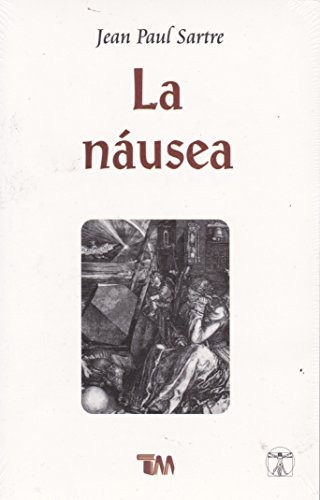
Nausea
Jean-Paul Sartre · 1905–1980 · France
Originally La Nausée (French)
Why it matters
Roquentin, alone in a provincial town, is overcome by the sheer gratuitous existence of things: a chestnut root becomes a metaphysical event. Existentialism's founding novel: philosophy made visceral.
At a glance
Diary form carrying dense phenomenological and philosophical argument.
Deep dive
The chestnut root gets all the attention; the quieter turn is what a jazz record convinces Roquentin he might do about it.
Written for readers who have finished the book. No plot recap, and nothing here is safe to read first.
Themes & symbolism
"Nausea" takes the driest possible philosophical claim — that existence precedes essence, that things carry no built-in meaning or necessity, they simply, superfluously are — and renders it as bodily revulsion rather than argument. The chestnut root in the park is the novel's proof: Roquentin stares at it until the word "root," and every category and function that word carries (roots support trees, roots are brown, roots are ordinary), simply stops working, and what is left is a black, gnarled, obscenely particular thing that language can no longer hold at arm's length. That collapse is the nausea itself — not disgust at any specific object but the vertigo of glimpsing, even briefly, the arbitrary scaffolding of names and uses that normally stands between a person and the sheer fact of things existing.
The diary form makes this a book about the impossibility of narrating a life honestly. Roquentin's own project, a biography of the obscure Rollebon, depends on imposing exactly the kind of retrospective order and necessity on a dead man's life that the nausea has just revealed to be a lie about lived experience — a life only feels necessary and dramatic after it is over and someone is choosing which facts to keep, and Roquentin's crisis is precisely that he can no longer perform that dishonesty on paper without recognizing what it costs.
Two Failed Answers to Contingency
Anny, Roquentin's former lover, offers a second case study rather than a solution. She built her life around cultivating "perfect moments" — deliberately staged, aesthetically complete scenes she tried to live inside — and by the time she and Roquentin meet again she has abandoned the project, having reached her own version of his disillusionment from the opposite direction: not too little meaning but the exhausting failure of manufacturing it on purpose. Sartre uses her to universalize Roquentin's crisis; it is not a personal breakdown, it is what happens to anyone who examines the machinery closely enough, whichever direction they approach it from.
The Self-Taught Man offers a third, gentler failure. He is working his way through the town library in strict alphabetical order, convinced that reading everything, in any sequence, adds up to humanist wisdom, and his public disgrace late in the novel punctures that faith as thoroughly as the chestnut root punctures Roquentin's sense of essence — his love of "Man" in the abstract turns out to have no more grounding than the naming-schemes Roquentin has already watched collapse. Between Anny's abandoned aestheticism and the Autodidact's exposed humanism, Sartre surrounds Roquentin's crisis with other people's failed systems for keeping contingency at bay, so that his nausea reads less like an isolated breakdown than the one honest response among several dishonest ones.
The last seal: what actually happens, and why it lands the way it does.
The ending, explained
Roquentin abandons the Rollebon biography once he recognizes it as exactly the bad faith the nausea has been diagnosing all along — imposing a dead man's false necessity onto contingent, arbitrary events. Listening to "Some of These Days" in a café just before he leaves Bouville, he notices that the recording, unlike a lived moment, is fixed: its notes exist in an unchangeable, necessary sequence outside of time, made rather than merely suffered, and that distinction gives him his one clear idea of how a person might respond to contingency instead of simply being sickened by it. He resolves to leave for Paris and attempt a novel of his own — not a cure, not a redemption, just a tentative bet that deliberately making something might be different from pretending meaning was already there to find.