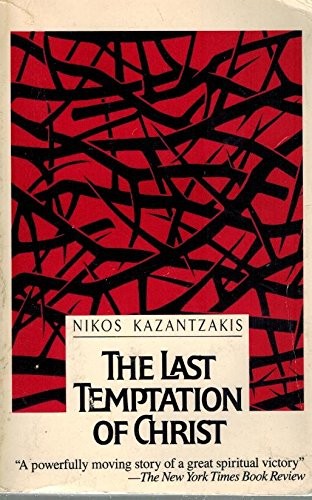
The Last Temptation of Christ
Nikos Kazantzakis · 1883–1957 · Greece
Originally Ho Teleftaios Peirasmos (Greek)
Why it matters
Christ on the cross imagines an alternate life of marriage, children, and ordinary contentment, and must reject it to complete his sacrifice. Kazantzakis's most controversial book, condemned by the Vatican and threatened with excommunication by the Orthodox Church, dramatizes divinity's struggle against the ordinary pull of the flesh.
At a glance
Dense theological and psychological argument runs beneath a straightforward narrative frame.
Deep dive
A carpenter tormented by desire, doubt, and guilt over the crosses he's built for the Romans becomes Kazantzakis's version of Christ, making the eventual choice of crucifixion a real struggle rather than a foregone conclusion.
Written for readers who have finished the book. No plot recap, and nothing here is safe to read first.
Themes & symbolism
Kazantzakis builds his Christ around a lifelong philosophical preoccupation with the war between flesh and spirit, shaped by his reading of Bergson and Nietzsche, giving Jesus real physical desire, real terror of death, and real doubt about his own mission rather than the settled, untroubled divinity of catechism. The point is not to diminish Christ but to make the eventual choice of the cross an actual moral achievement, a man overcoming appetites and fears that are rendered as genuinely powerful rather than as temptations he was always guaranteed to shrug off.
Judas, traditionally Christianity's paradigmatic traitor, becomes in this version Christ's strongest and most loyal disciple, the one man capable of carrying out a betrayal that Jesus himself insists must happen, since the crucifixion cannot occur without it. Kazantzakis inverts the gospel hierarchy entirely, making obedience to a horrifying command the highest form of loyalty rather than its opposite, a reversal severe enough that it drove much of the controversy that followed the book for decades.
Before his ministry, this Jesus works as a carpenter building crosses for the Roman occupiers, a detail Kazantzakis invents to load his hero with a specific, corrosive guilt, that his own hands helped construct the machinery his people are executed on, before he ever preaches a word against it. His earlier bond with Mary Magdalene, whose descent into prostitution he feels responsible for having failed to prevent when he had the chance, gives the later crucifixion vision its exact shape, a stolen ordinary life with the one woman his guilt keeps circling back to.
Banned, Excommunicated, and Still Filmed
The Catholic Church placed the novel on the Index of Forbidden Books and Kazantzakis, already a target of the Greek Orthodox Church for earlier work, faced renewed calls for excommunication over its portrayal of Christ's doubt and desire; he responded by requesting, unsuccessfully, that the Church simply try him rather than condemn him unheard. The controversy resurfaced decades later when Martin Scorsese's 1988 film adaptation drew protests and boycotts largely from audiences who had never read Kazantzakis's own introduction, where he frames the struggle between flesh and spirit as the defining fight of every human life, Christ's included, not as an attack on faith but as an argument for how hard faith is actually supposed to be.
The last seal: what actually happens, and why it lands the way it does.
The ending, explained
On the cross, this Christ is granted a vision by what he takes for a guardian angel but which is actually Satan in disguise, an entire alternate life playing out as if real: he descends from the cross, takes Mary Magdalene as his wife and, after her early death, Mary and Martha as well, fathers children, and grows old in ordinary domestic peace, mission abandoned. Decades into this vision, an aged Judas finds him and accuses him of betraying his own purpose, breaking the illusion's spell, and Christ, recognizing the false peace for what it is, wills himself back to the actual cross and actual death, crying out that it is accomplished. Kazantzakis frames the vision not as weakness but as the necessary last temptation, since a man who was never tempted by an ordinary life could never meaningfully choose to give one up.