
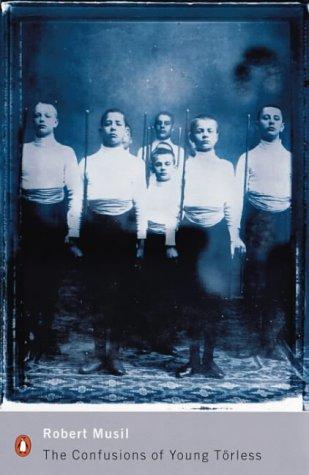
Young Törless
Robert Musil · 1880–1942 · Austria
Originally Die Verwirrungen des Zöglings Törleß (German)
Why it matters
A student at an Austrian military academy watches, half-complicit, as classmates torture a boy caught stealing. Musil's cold, exacting debut anatomizes the psychology of cruelty and moral abdication that would soon engulf Europe.
At a glance
Cold, analytical prose probing psychological cruelty with philosophical precision.
Deep dive
A student's clinical, almost scientific fascination with watching a classmate tortured, and what his refusal to simply condemn or excuse it says about the psychology that would soon engulf Europe.
Written for readers who have finished the book. No plot recap, and nothing here is safe to read first.
Themes & symbolism
Törless is neither instigator nor victim in the abuse of Basini — Reiting and Beineberg supply the sadism, blackmailing and progressively humiliating the boy who stole to pay a debt — and that's precisely Musil's point: Törless's role is to watch, analyze, and permit, treating the whole escalating cruelty as raw material for a private, quasi-philosophical inquiry into what rational bourgeois consciousness is actually built on top of. His fascination is aestheticized and detached rather than gleeful, a scientist's curiosity applied to atrocity, and Musil is diagnosing exactly this capacity — the intellectual's ability to rationalize and observe cruelty as *interesting* rather than intolerable — as a specific psychological condition, not an aberration.
Written in 1906, the novel reads with hindsight as an anatomy of the moral relativism and detached cruelty that would produce fascism a generation later: Törless's dual consciousness, orderly schoolwork by day and complicity in torture by night, prefigures a civilization capable of holding both without apparent contradiction. The school itself, an institution built to produce disciplined, rational men, turns out to be the perfect incubator for exactly the opposite.
A Debut Ahead of Its Diagnosis
Musil wrote Törless well before the political catastrophes it now reads as prophesying, which is exactly what gives the novel its unsettling authority: it isn't hindsight dressed up as foresight but a genuinely original piece of psychological observation, made at a moment when the vocabulary for what it describes barely existed. Musil's own later, unfinished masterwork The Man Without Qualities returns to the same terrain from an adult vantage — a society fluent in rational self-justification and correspondingly blind to what that fluency lets it excuse — but it's the schoolboy setting here, with its miniature, closed-off hierarchy of masters, prefects, and victims, that makes the mechanism visible in its simplest, most legible form.
The last seal: what actually happens, and why it lands the way it does.
The ending, explained
Once Basini's treatment is finally exposed to the faculty, Törless is questioned and gives an answer that unsettles his teachers more than a confession would — he can't or won't condemn what happened in the simple moral terms they're fishing for, instead groping toward the strange doubled awareness he experienced and failing to make it legible to them. Withdrawn from the school by his mother, he re-enters ordinary bourgeois life with the whole experience folded away rather than resolved, the novel ending on ambiguity rather than judgment because judgment is exactly what its protagonist has just proven incapable of delivering cleanly.
Where to go next
 Robert Musil · 1930The Man Without QualitiesLvl 9Slow burn
 Ingeborg Bachmann · 1971MalinaLvl 8Slow burn
 Milan Kundera · 1984The Unbearable Lightness of BeingLvl 5Slow burn
 Elias Canetti · 1935Auto-da-FéLvl 7Slow burn
 Franz Kafka · 1915The MetamorphosisLvl 4Medium pace
 Stefan Zweig · 1942Chess StoryLvl 4Fast paced