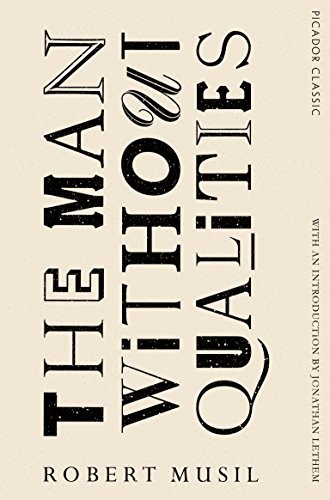
The Man Without Qualities
Robert Musil · 1880–1942 · Austria
Originally Der Mann ohne Eigenschaften (German)
Why it matters
Vienna, 1913: a committee plans an imperial jubilee that history will cancel. Musil's unfinished giant treats ideas the way Proust treats memory: the great essayistic novel, and the wittiest autopsy of a civilization ever left open on the table.
At a glance
Essayistic, unfinished, and structured around ideas rather than plot momentum.
Deep dive
A committee spends the whole novel hunting for the perfect symbol of an empire that history is about to delete — Musil's joke is that nobody in the room can tell world-historical meaning apart from a scheduling problem.
Written for readers who have finished the book. No plot recap, and nothing here is safe to read first.
Themes & symbolism
Ulrich's condition of having 'qualities without a man to hold them' isn't a deficiency so much as a diagnosis of modern selfhood: he's talented at everything and committed to nothing, treating every possible identity — soldier, mathematician, lover, reformer — as one hypothesis among many rather than a truth to inhabit. Musil makes this a civilizational condition, not a personal quirk, embodied in the Parallel Campaign, a committee of aristocrats and industrialists earnestly trying to design a jubilee that expresses the 'true meaning' of Austrian civilization, unaware the civilization in question has no meaning left to express and only a few years left to exist.
The satire works because nobody on the committee is stupid — they're erudite, well-meaning, and endlessly articulate, which is exactly the joke: sophistication has become a way of not noticing the obvious. Musil's essayistic digressions, pausing scenes to reason through ethics, statistics, or the psychology of crowds, apply something like Proust's density of attention to ideas instead of memory, so the novel reads less like a story with commentary attached than commentary that occasionally remembers to have a story. Ulrich's later, increasingly private retreat into near-mystical intimacy with his sister Agathe reads as his one serious attempt to live a value rather than merely analyze one — a utopia built for two, set against a public sphere of pure talk.
Ulrich and Agathe
The sibling relationship that dominates the novel's later sections isn't a digression from the Parallel Campaign plot, it's the plot's rebuttal — where the committee produces only language about ultimate meaning, Ulrich and Agathe try to actually construct a shared ethical and emotional absolute between two people, circling incest as the furthest possible test of a bond with no external social sanction behind it. Musil treats their intimacy with total seriousness rather than scandal, as the novel's real experiment in whether meaning can still be built at all once the public forms for it have gone hollow.
Kakania
Musil's nickname for Austria-Hungary, drawn from the k.u.k. ('kaiserlich und königlich,' imperial-and-royal) abbreviation stamped on everything official, turns the empire itself into a running joke about a state that exists mostly as title and paperwork — magnificently bureaucratic, administratively real, and, the novel keeps implying, already halfway to fictional even before 1914 arrives to finish the job.
The joke has a serious underside: Kakania is Musil's way of saying that a civilization can be simultaneously the most rationally administered in Europe and the least able to perceive its own condition, since every committee, ministry, and salon in the novel is fluent in analysis and blind to consequence. The Parallel Campaign is simply Kakania's method applied to its own commemoration — form without content, procedure standing in for the meaning it was supposed to produce.
The last seal: what actually happens, and why it lands the way it does.
The ending, explained
There is no ending in the ordinary sense: Musil worked on the novel for roughly two decades, published its first two parts in 1930 and 1932, and was still drafting and revising the continuation — including where to take Ulrich and Agathe — when he died in 1942, leaving hundreds of pages of drafts and false starts that editors later assembled from his papers. That incompletion isn't a flaw external to the book so much as an accidental confirmation of its own argument: a novel about the impossibility of settling on one final shape for a self, an era, or an idea ends, fittingly, without ever settling on one for itself.