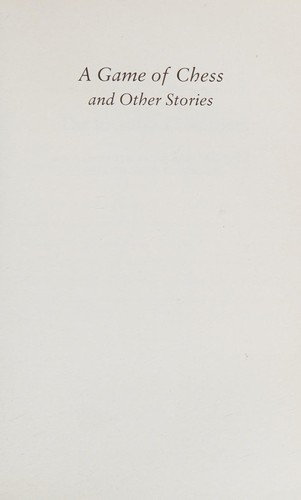
Chess Story
Stefan Zweig · 1881–1942 · Austria
Originally Schachnovelle (German)
Why it matters
Aboard an ocean liner, an unbeatable chess champion faces a mysterious stranger who learned the game alone in Gestapo isolation, replaying grandmaster matches in his head until it nearly broke him. Zweig's last work compresses his era's whole catastrophe into one game.
At a glance
Short and lucid, though the nested wartime confession demands close attention.
Deep dive
What happens when the only opponent left in an empty cell is your own mind, and why a shipboard rematch years later starts to feel like the same room.
Written for readers who have finished the book. No plot recap, and nothing here is safe to read first.
Themes & symbolism
Czentovic is the novel's portrait of talent without depth — a chess mind with no other furniture in it, unbeatable and faintly grotesque, a champion built by nothing but pure mechanical gift. Dr. B. is his opposite in every way that matters and the novel's real subject: an amateur whose relationship to chess was forged not through study but through survival, the stolen book of grandmaster games becoming, in his Gestapo cell, the only intellectual object left to keep his mind from dissolving under engineered boredom. Zweig is precise about the method of the torture — no beatings, just isolation and uncertainty, the regime having learned that a cultivated mind can be broken more efficiently by emptiness than by pain.
The split into a "Black" self and a "White" self, Dr. B. playing chess against his own mind because there is no other opponent available, dramatizes exactly what totalitarian isolation does to interiority: it doesn't just deprive a person of company, it turns the self into its own adversary. Zweig, writing this in exile in Brazil in the last months of his life, was watching the European culture that had shaped him get systematically dismantled, and the novella reads as his verdict on that culture's fate — even its most fortified, most cultivated minds turn out to have a breaking point.
A Farewell Letter
Zweig and his wife took their own lives within months of finishing the manuscript, in Brazilian exile, despairing that the humane, cosmopolitan Europe that had formed him was gone for good and unlikely to return in his lifetime. Read against that fact, Dr. B.'s carefully cultivated mind — stocked with languages, law, and culture, and still no match for a totalitarian system's capacity to weaponize emptiness — reads less like a character study than a diagnosis Zweig had already delivered on himself. He had been, before the war, one of the most translated writers alive, at home in exactly the kind of cultivated, cosmopolitan European milieu the novella mourns; watching that world close its borders to him personally sharpened the book's abstractions into something closer to autobiography.
The last seal: what actually happens, and why it lands the way it does.
The ending, explained
In the shipboard rematch against Czentovic, arranged partly for sport and partly so the passengers can watch a real amateur test the champion, Dr. B. wins the first game cleanly and agrees, against his own instinct, to a second. Under the pressure of sustained competitive play, his old habit relapses in real time: he starts conducting the game not against Czentovic but against his remembered other self, muttering, losing track of which board he's actually at, visibly sliding back into the mental state of his cell. He has to break off the match mid-game and vow, shaken, never to touch a chessboard again. Nothing was ever cured, only suppressed — Zweig's last, bleak demonstration that some damage doesn't heal, it just waits for the right pressure to reopen.