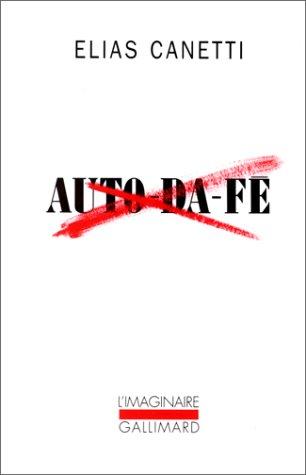
Auto-da-Fé
Elias Canetti · 1905–1994 · Bulgaria / UK
Originally Die Blendung (German) · translated by C.V. Wedgwood
Why it matters
A reclusive sinologist's total devotion to his private library isolates him so completely that reality itself begins to unravel. A singular, disturbing study of erudition curdling into madness on the eve of fascism.
At a glance
Dense, mounting interior monologue circling a mind coming apart.
Deep dive
A sinologist so devoted to his twenty-five-thousand-volume library that he can't tolerate another mind sharing the apartment — and Canetti's argument about where that kind of purity actually leads is not for the faint of heart.
Written for readers who have finished the book. No plot recap, and nothing here is safe to read first.
Themes & symbolism
Peter Kien's twenty-five-thousand-volume library, catalogued with obsessive precision and defended from any human contact that might damage it, is the novel's central image of pure intellect walled off from the world so completely that it curdles into pathology: Kien can recite classical Chinese texts from memory but is unable to recognize his housekeeper Therese's transparent greed when she manufactures affection to get at his money, a blindness Canetti frames as the direct cost of a mind that has spent decades treating books as more real and more trustworthy than people.
Canetti structures the novel in three movements — 'A Head Without a World' (Kien's insulated scholarly life before Therese), 'Headless World' (Kien cast out into Vienna's underworld of pawnbrokers, dwarves, and violent doormen after Therese seizes the apartment), and 'The World in the Head' (his brother Georges's futile attempt to restore order) — a scheme that literalizes its own title: intellect divorced from body and society in the first section, brute appetite and violence divorced from any organizing intelligence in the second, and a final, failed effort to reunite them in the third. The tripartite structure insists that neither pure abstraction nor pure chaos can function alone, and that Kien's later total breakdown is the predictable result of having spent a lifetime in the first without any capacity to survive contact with the second.
Written in 1931 and published in 1935, as European fascism's mass irrationalism was becoming impossible to ignore, the novel functions as Canetti's bleak allegory for how supposedly civilized, hyper-rational culture can produce, rather than prevent, its own descent into violence and unreason — Kien's scholarly detachment doesn't protect him from the mob logic surrounding him (embodied in the brutal, paranoid caretaker Benedikt Pfaff and the scheming dwarf Fischerle, who dreams of reinventing himself as an American chess champion) so much as leave him with no defenses against it once his insulated world is breached, a diagnosis Canetti would later develop at book length in his nonfiction study Crowds and Power.
A Novel Written Toward an Unwritten Comédie Humaine
Canetti originally conceived Die Blendung as one volume in a planned eight-novel cycle depicting different kinds of 'monomaniacs,' modeled loosely on Balzac's ambition in the Comédie Humaine, though he completed only this single installment; its 1935 Vienna publication drew comparatively little notice at the time; and Canetti's own emigration from Austria after the 1938 Anschluss and the novel's 1946 English translation (championed by figures including Iris Murdoch) helped build its reputation gradually over decades rather than at once. His 1981 Nobel Prize in Literature, awarded 'for writings marked by a broad outlook, a wealth of ideas and artistic power,' cited this novel specifically among his major achievements, decades after its initial muted reception.
The last seal: what actually happens, and why it lands the way it does.
The ending, explained
Kien's brother Georges, a celebrated Paris psychiatrist, arrives in Vienna, evicts Therese and Pfaff, redeems the pawned books, and restores Peter to his refurnished apartment — but Georges's confidence that a competent outsider can simply diagnose and repair his brother's condition proves as much an overestimation of rational mastery as Peter's own scholarly detachment ever was. Left alone again, now fully insane, Peter imagines his books are under attack and, in the final scene, methodically sets his library on fire, climbs a ladder amid the flames, and dies laughing — a climax Canetti stages without sentimentality, the collector's total identification with his collection resolving into self-annihilating destruction of both. The title's 'auto-da-fé' (historically the ritual burning of heretics) recasts Kien's death as a perverse rite: a mind that made scholarship into a substitute god finally immolates itself on that altar.